
Body Contouring in Islamabad
Body Contouring refers to aesthetic treatments designed to reshape or improve the appearance of selected areas of the body. Non-surgical body contouring may use controlled cooling, radiofrequency energy, ultrasound or other device-based technologies to reduce small areas of unwanted fat, improve selected skin laxity or temporarily improve the appearance of cellulite.
Body Contouring is not a weight-loss treatment or treatment for obesity. Non-invasive procedures are generally best suited to patients who are relatively close to a stable body weight but have localised areas of fat or contour concerns that remain despite diet and exercise. Patients with substantial excess fat, significant loose skin or major post-weight-loss skin excess may require surgical procedures such as liposuction, abdominoplasty or body lift instead.
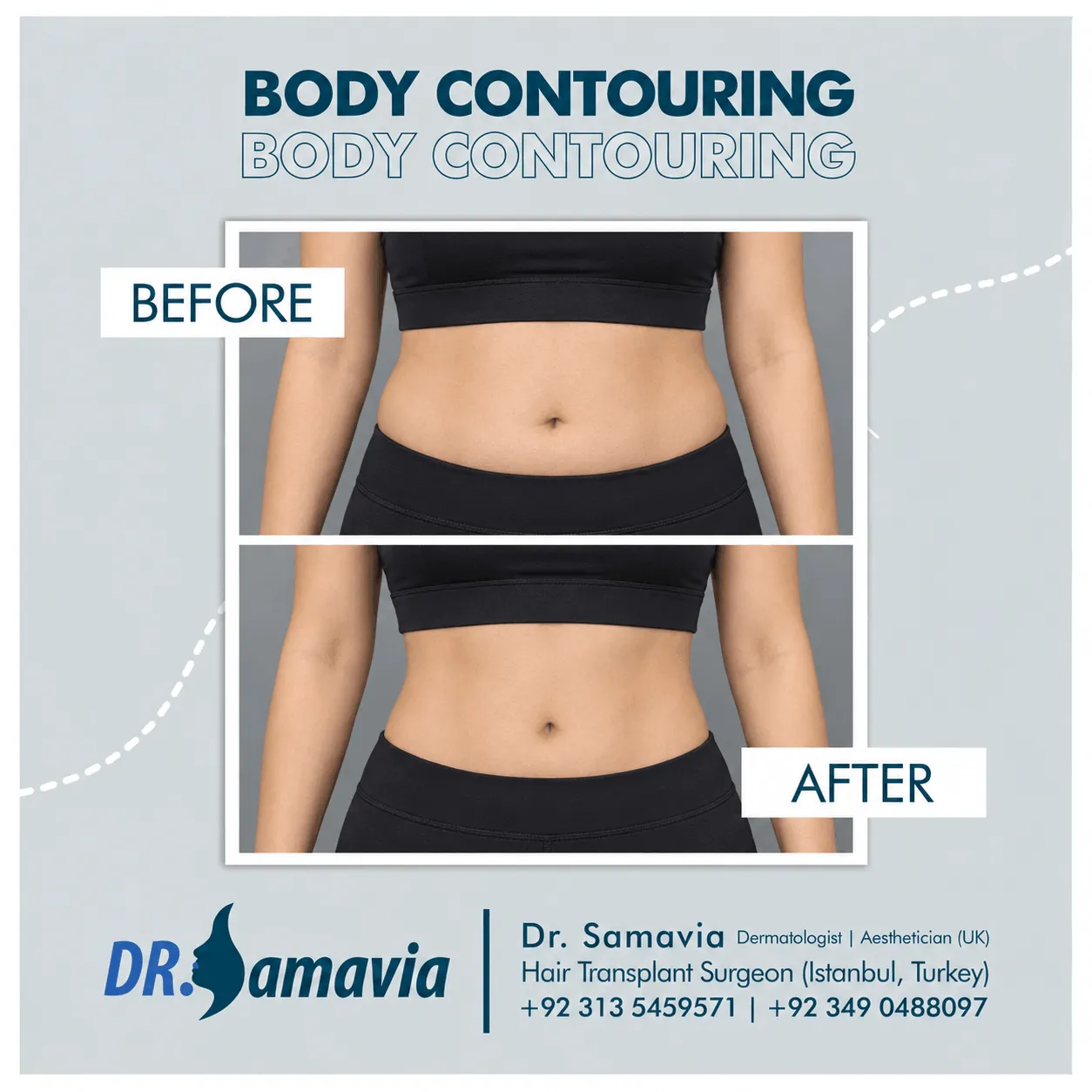
What is Body Contouring?
Body Contouring, also called body sculpting, is an umbrella term describing procedures intended to modify the shape, circumference or visible contour of selected body areas.
The U.S. FDA describes body contouring as procedures that may aim to:
- Change the circumference of areas such as the waist or thighs
- Reduce small areas of excess fat
- Improve selected muscle tone or firmness
- Improve the appearance of cellulite
Non-invasive body contouring does not surgically remove skin or fat from the body. This distinguishes it from procedures such as liposuction, tummy tuck or body lift.
Depending on the patient's concern, treatment may involve:
- Cryolipolysis or fat freezing
- Radiofrequency treatment
- Ultrasound-based fat reduction
- Selected laser or heat-based technologies
- Muscle-stimulation technologies where appropriately indicated
- Cellulite-focused procedures
- Combination treatment
No single technology is appropriate for every body-contouring concern.
What Is Body Contouring Used For?
Non-surgical Body Contouring may be considered for selected areas such as:
- Abdomen
- Flanks or love handles
- Inner thighs
- Outer thighs
- Upper arms
- Back
- Bra-line area
- Under the chin
- Selected areas around the knees
The American Academy of Dermatology notes that non-invasive fat-reduction techniques can be used on areas including the abdomen, flanks, thighs, chin, neck, back, upper arms and knees.
Treatment may address:
- Small localised fat bulges
- Mild body-contour irregularities
- Selected mild skin laxity
- Cellulite appearance
- Specific areas resistant to lifestyle-related fat loss
Body contouring should not be used as a substitute for appropriate management of overweight or obesity.
What concerns can it address?
Localised abdominal fat
A patient may maintain a relatively stable weight but still have a small localised abdominal fat deposit.
Selected non-invasive fat-reduction technologies may reduce the thickness of this superficial fat layer.
Love handles
Localised fat at the sides of the waist can sometimes be treated using cryolipolysis, radiofrequency, ultrasound or another appropriate technology.
Thigh contour
Inner or outer thigh bulges may be treated in appropriately selected patients.
The treatment should be planned according to whether the main concern is:
- Fat
- Skin laxity
- Cellulite
- A combination of concerns
Upper-arm contour
Small areas of arm fat may respond to certain body-contouring technologies.
Substantial loose upper-arm skin, however, is unlikely to be corrected adequately with non-surgical fat reduction alone.
Double chin
Selected technologies can reduce submental fat.
Some jurisdictions also have approved injectable treatments for submental fat.
A double chin may also result partly from:
- Skin laxity
- Chin structure
- Neck anatomy
so fat reduction alone is not always sufficient.
Cellulite
Some body-contouring devices are intended to temporarily improve the dimpled appearance of cellulite.
Cellulite involves the relationship between:
- Skin
- Connective tissue
- Underlying fat
and therefore should not be described simply as excess body fat.
Mild skin laxity
Certain radiofrequency and heat-based technologies may create a temporary tighter appearance through effects on collagen and supporting tissues.
These treatments cannot remove substantial amounts of loose skin.
Types of Non-Surgical Body Contouring
Cryolipolysis — Fat Freezing
Cryolipolysis uses controlled cooling to damage fat cells.
The treated fat is gradually cleared through the body's biological processes over the following weeks and months.
The FDA states that damaged fat from cryolipolysis is generally cleared over approximately 2 to 3 months.
It may be considered for selected pinchable fat bulges.
Radiofrequency Body Contouring
Radiofrequency uses electrical energy to create controlled heating within targeted tissues.
Depending on the device, RF treatment may aim to:
- Reduce selected fat thickness
- Temporarily reduce circumference
- Improve the appearance of cellulite
- Produce a tighter-looking skin surface
RF devices differ considerably, and not every RF machine is intended or authorised for body contouring.
Ultrasound Fat Reduction
Therapeutic ultrasound uses sound-wave energy delivered through the skin.
Depending on the technology, energy can disrupt selected fat cells and gradually reduce the circumference of the treated area.
Correct coupling between the device and skin is important because inappropriate ultrasound treatment can cause burns or other tissue injury.
Other Energy-Based Treatments
Other body-contouring technologies may use:
- Heat
- Laser energy
- Electromagnetic energy
- Mechanical stimulation
- Combination technologies
The exact intended use and regulatory status should be checked for the specific device.
Potential benefits
Potential benefits of non-surgical Body Contouring include:
- No surgical incision
- Usually no general anaesthesia
- Minimal downtime with many treatments
- Can target selected small fat deposits
- Gradual, natural-looking contour change
- Can treat multiple body regions
- Certain technologies may improve mild skin firmness
- Some technologies may temporarily improve cellulite
- Treatment can be customised by body area
- Patients generally return to normal activities relatively quickly
For appropriate candidates with a relatively small resistant fat bulge, non-invasive treatment can provide measurable improvement without liposuction.
The AAD notes that because selected non-invasive treatments destroy fat cells, reduction of those particular treated cells can be long-lasting. However, remaining cells can still enlarge if the patient gains weight.
Limitations and realistic expectations
Body Contouring is not weight-loss treatment.
The FDA specifically states that non-invasive body contouring:
- Does not treat obesity
- Does not result in meaningful weight loss
- Does not provide the health benefits associated with losing excess body weight
The treatment is intended primarily to modify the appearance of selected areas.
Non-surgical Body Contouring also cannot guarantee:
- Major weight reduction
- Large-volume fat removal
- Surgical-level body reshaping
- Complete cellulite removal
- Permanent skin tightening
- Removal of major excess skin
- A completely flat abdomen
- Identical results in every patient
Results tend to be more modest than surgical liposuction.
The American Society of Plastic Surgeons notes that non-surgical fat-reduction techniques are not replacements for liposuction, particularly when larger amounts of fat need to be removed.
Patients should be cautious about claims such as:
- “Lose 10 kg without diet”
- “Permanent weight loss without exercise”
- “One-session complete belly-fat removal”
- “Same result as liposuction”
- “Zero-risk fat freezing”
- “Permanent cellulite removal”
These claims are not realistic.
Body Contouring and Weight Loss
Fat reduction and weight loss are different goals.
When body weight decreases through nutrition, physical activity or medical weight management, existing fat cells generally become smaller.
Certain body-contouring procedures instead destroy or damage a portion of fat cells within a specific treatment area.
This can improve a localised bulge without substantially changing total body weight.
For this reason, a patient may notice a change in:
- Waist contour
- Localised bulge
- Clothing fit
- Body silhouette
without seeing a major change on the weighing scale.
Patients primarily seeking substantial weight loss should first discuss evidence-based weight-management options rather than relying on cosmetic body contouring.
Who may be suitable?
Non-surgical Body Contouring may be considered for adults who:
- Have a relatively stable weight
- Have small localised fat deposits
- Are relatively close to their desired body weight
- Have realistic expectations
- Prefer to avoid surgery
- Understand that several sessions may be required
- Have suitable skin and tissue characteristics
The AAD describes a typical good candidate for non-invasive fat reduction as someone with a relatively normal weight who has a small bulge of fat that remains despite diet and exercise.
An assessment should consider:
- Body weight
- Fat distribution
- Skin laxity
- Cellulite
- Previous surgery
- Hernias
- Medical conditions
- Implants
- Treatment expectations
Who may not be suitable?
Suitability depends substantially on the specific technology.
Treatment may be inappropriate or require additional assessment for patients with:
- Pregnancy
- Breastfeeding
- Active infection
- Open wounds
- Significant skin injury
- Certain implanted medical devices
- Significant uncontrolled medical illness
- Severe obesity when the expectation is weight loss
- Major excess skin requiring surgical correction
- Certain circulation disorders
- Hernias in or near the intended treatment area
Cryolipolysis contraindications
Fat freezing should not be performed in patients with certain cold-related disorders such as:
- Cryoglobulinemia
- Cold urticaria
- Paroxysmal cold haemoglobinuria
- Cold agglutinin disease
- Significant cold-related circulation problems in the treatment area
The FDA also advises avoiding treatment in or near an existing hernia or structurally weak abdominal area.
Radiofrequency considerations
Some RF procedures may be inappropriate in patients with:
- Pacemakers
- Implantable cardioverter-defibrillators
- Certain metal implants in the treatment area
The specific device's instructions must be followed.
How to prepare
Before Body Contouring, tell your clinician about:
- Medical conditions
- Previous surgery
- Hernias
- Pregnancy or breastfeeding
- Pacemaker or implanted device
- Metal implants
- Cold-sensitivity disorders
- Circulation problems
- Previous body-contouring treatments
- Medication
- Blood-thinning medication
- Allergies
- Skin conditions
- Recent changes in weight
The clinician should identify:
- The specific problem being treated
- The technology proposed
- Device name
- Intended treatment area
- Expected number of sessions
- Expected magnitude of improvement
- Possible complications
Patients should ideally be at a reasonably stable weight before beginning a cosmetic body-contouring programme.
How the procedure works
The exact procedure depends on the technology.
1. Body assessment
The clinician evaluates:
- Fat distribution
- Skin quality
- Tissue thickness
- Cellulite
- Treatment area
- Existing asymmetry
2. Treatment-area marking
The areas requiring treatment may be marked while the patient is standing.
3. Photography and measurements
Baseline photographs or circumference measurements may be taken to allow future comparison.
4. Device selection
The technology is chosen according to the patient's anatomy and concern.
5. Treatment
Cryolipolysis
An applicator is placed over the selected fat bulge.
Vacuum may draw tissue into the applicator before controlled cooling is delivered.
Treatment may continue for up to approximately an hour depending on the device.
Radiofrequency
An RF applicator delivers controlled thermal energy to selected tissue.
The patient usually feels warmth.
Ultrasound
Ultrasound gel is applied to create appropriate contact before controlled sound-wave energy is delivered.
6. Final assessment
The treated area is examined for unexpected reactions.
7. Follow-up
Results are assessed after enough time has passed for biological changes to develop.
Additional sessions may then be considered.
Results and treatment timeline
Non-surgical body-contouring results usually develop gradually.
Immediately after treatment
There may be little visible reduction initially.
Temporary effects can include:
- Redness
- Swelling
- Tenderness
- Bruising
- Altered sensation
Around 3 weeks
The AAD notes that some patients undergoing non-invasive fat removal can begin noticing changes from approximately 3 weeks after treatment.
Around 2 to 3 months
Fat reduction often becomes easier to assess as damaged cells are gradually cleared.
For cryolipolysis, the FDA notes that this process commonly takes approximately 2 to 3 months.
Number of treatments
Treatment requirements vary considerably.
AAD guidance provides broad examples:
- Cryolipolysis: commonly around 2 treatments
- Ultrasound: approximately 1 to 3 treatments depending on device
- Radiofrequency: approximately 4 to 10 treatments in some protocols
These are general examples rather than universal schedules.
Long-term
Destroyed fat cells do not simply regrow.
However, remaining fat cells can enlarge if the patient gains weight.
Maintaining a reasonably stable weight therefore helps preserve the contour improvement.
Risks and side effects
Every Body Contouring technology has its own risk profile.
General temporary effects may include:
- Pain
- Tenderness
- Redness
- Swelling
- Bruising
- Temporary lumps or nodules
- Temporary numbness
The FDA notes that while many complications are temporary, some body-contouring complications can persist, become permanent or require surgery.
Cryolipolysis risks
Possible effects include:
- Pain
- Bruising
- Swelling
- Skin-colour changes
- Numbness
- Nodules
- Freeze burns
- Nerve-related symptoms
Paradoxical Adipose Hyperplasia
A rare but important complication of cryolipolysis is paradoxical adipose hyperplasia (PAH).
Instead of becoming smaller, fat tissue in the treatment area grows and can form a firm, visible bulge that may resemble the shape of the treatment applicator.
The FDA states that PAH has been reported approximately 2 to 5 months after fat-freezing treatment, does not resolve spontaneously and may require surgery.
Radiofrequency risks
Potential complications can include:
- Pain
- Burns
- Blisters
- Skin injury
- Pigmentation changes
- Nodules
depending on the device and energy delivered.
Ultrasound risks
Potential complications include:
- Pain
- Redness
- Swelling
- Blisters
- Burns
- Nerve damage
The FDA notes that therapeutic ultrasound can cause tissue burns when used incorrectly.
Pigmentation changes
Some body-contouring treatments can cause:
- Hyperpigmentation
- Hypopigmentation
The FDA specifically advises that darker skin types may have a risk of darkening or lightening following certain procedures.
Recovery and aftercare
Many non-invasive Body Contouring treatments require little downtime.
Patients may be able to return to work and routine activities on the same day.
Temporary:
- Redness
- Bruising
- Tenderness
- Swelling
- Numbness
may persist depending on the treatment.
Aftercare depends on the technology.
General advice may include:
- Follow device-specific instructions.
- Keep the treated skin clean.
- Avoid excessive rubbing if the area is tender.
- Maintain normal hydration.
- Resume exercise according to practitioner advice.
- Avoid exposing injured or irritated skin to excessive heat or sunlight.
- Maintain a relatively stable weight.
- Attend recommended follow-up assessment.
Contact your clinic for:
- Severe or increasing pain
- Significant blistering
- Burns
- Persistent numbness
- Significant swelling
- Skin breakdown
- Signs of infection
- An enlarging firm bulge developing after fat freezing
- Another unexpected reaction
Alternatives and comparisons
Body Contouring vs Liposuction
These treatments are significantly different.
Non-Surgical Body Contouring
- No surgical incision
- Usually no anaesthesia
- Limited downtime
- Gradual results
- Best for relatively small fat deposits
- Often requires multiple treatments
Liposuction
Liposuction is a surgical procedure.
A narrow cannula is inserted through small incisions to physically remove fat.
It can produce greater-volume fat reduction and more dramatic contour change than non-invasive technologies.
However, it also involves:
- Surgical recovery
- Swelling
- Bruising
- Anaesthesia considerations
- Infection risk
- Other surgical complications
ASPS specifically states that non-surgical fat reduction should not be considered a replacement for liposuction.
Body Contouring vs Weight Loss
Weight loss reduces overall body mass and has potential health benefits for people with excess weight.
Body Contouring modifies specific areas for cosmetic purposes.
The FDA specifically states that non-invasive body contouring does not provide the health benefits associated with weight loss.
Body Contouring vs Tummy Tuck
A tummy tuck or abdominoplasty is surgery that can remove substantial loose abdominal skin and address selected abdominal-wall concerns.
Non-surgical body contouring does not cut away excess skin.
Patients with substantial loose skin following:
- Pregnancy
- Significant weight loss
- Ageing
may therefore obtain limited improvement from non-invasive treatment.
Body Contouring vs Body Lift
A surgical body lift removes excess sagging skin and fat and reshapes supporting tissues, particularly after major weight loss.
ASPS notes that body-lift procedures may address areas such as the:
- Abdomen
- Buttocks
- Inner thighs
- Outer thighs
and are designed for concerns that non-invasive fat reduction cannot adequately correct.
Surgical body contouring also carries substantially greater risks, including bleeding, infection, blood clots, poor wound healing, fluid accumulation and scarring.
What affects the cost?
The cost of Body Contouring depends on:
- Technology used
- Treatment area
- Size of the area
- Number of applicators
- Number of treatment cycles
- Number of sessions
- Amount of localised fat
- Skin laxity
- Cellulite treatment
- Combination treatments
- Follow-up requirements
For example, treating a small area beneath the chin requires a different plan from treating:
- Abdomen
- Both flanks
- Inner thighs
- Multiple body areas
Patients should also ask for the exact device name and treatment technology rather than comparing treatments solely by the phrase “Body Contouring.”
The most expensive device is not automatically the best treatment.
Correct patient selection and matching the technology to the actual concern are more important.
Patient experiences
Reviews describe individual experiences and do not predict another patient's result.
I had a wonderful experience consulting with Dr. Samaviya Ejaz. She is an incredibly impressive and professional dermatologist. Her clinic is beautiful and has a calming atmosphere.
Umar Shah
Read on GoogleI had my hair fall consultation with Dr Samavia. She thoroughly explained the treatment. After PRF sessions my hair fall stopped and density improved. Highly recommend.
Moneeb Mumtaz
Read on GoogleI have had a few treatments at this clinic and I am happy with the outcomes. Dr. Samavia and her team are kind, professional, and trustworthy.
Sheikh Yousuf Kareem
Read on GoogleVisit Dr Samavia at Facetime Clinic
Use the verified Google profile for clinic directions, business details and linked patient reviews.
Clinical references
- Non-Invasive Body Contouring TechnologieU.S. Food and Drug Administration · accessed 30 August 2026
- Non-Invasive Fat Removal: What Can You Expect?American Academy of Dermatology · accessed 30 August 2026
- Nonsurgical Fat ReductionAmerican Society of Plastic Surgeons · accessed 30 August 2026
- Body Contouring: Risks and SafetyAmerican Society of Plastic Surgeons · accessed 30 August 2026
- Body LiftAmerican Society of Plastic Surgeons · accessed 30 August 2026
- How Skin Tightening Improves Liposuction Results and Body ContouringAmerican Society of Plastic Surgeons · accessed 30 August 2026
Body Contouring FAQs
Does Body Contouring help you lose weight?
No. Non-surgical Body Contouring is designed to reduce selected localised fat bulges or improve contour rather than produce meaningful weight loss. The FDA specifically states that non-invasive body contouring does not treat obesity and does not provide the health benefits associated with losing excess body weight.
How many Body Contouring sessions do I need?
The number depends on the technology, area and desired correction. AAD guidance gives broad examples of around two treatments for cryolipolysis, one to three for some ultrasound treatments and several sessions for certain radiofrequency protocols. The exact schedule should be based on the specific device rather than a fixed package for every patient.
Are Body Contouring results permanent?
When a fat-reduction treatment successfully destroys fat cells, those specific cells do not regenerate. However, other fat cells remain and can enlarge if you gain weight. Maintaining a relatively stable body weight is therefore important. Skin-tightening and cellulite improvements may also diminish with ageing and can require maintenance.
Is Body Contouring the same as liposuction?
No. Non-surgical Body Contouring uses external energy such as cold, heat or ultrasound to gradually reduce selected fat deposits. Liposuction is surgery in which fat is physically removed through a cannula inserted through small incisions. Liposuction can generally produce a greater degree of fat reduction but requires surgical recovery.
Is fat freezing safe?
Cryolipolysis can be performed safely in appropriately selected patients, but it is not risk-free. Temporary redness, bruising, swelling, pain and numbness can occur. Burns are possible, and a rare complication called paradoxical adipose hyperplasia can cause the treated fatty tissue to enlarge instead of shrink and may require surgery.
Other Body & Skin Procedures guides
Book a consultation in Islamabad to review suitability, alternatives, expected recovery and individual risks.