
Hair Transplant in Islamabad
Hair transplant is a surgical hair-restoration procedure in which healthy follicular units are moved from a suitable donor area—usually the back or sides of the scalp—to areas affected by permanent hair loss. Modern transplantation primarily uses two donor-harvesting approaches: Follicular Unit Excision (FUE) and Follicular Unit Transplantation using strip/linear excision (FUT).
Hair transplantation is most commonly performed for androgenetic alopecia, also known as male or female pattern hair loss. Results depend on correct diagnosis, donor-hair availability, hair characteristics, surgical planning, graft handling and the patient's future pattern of hair loss.
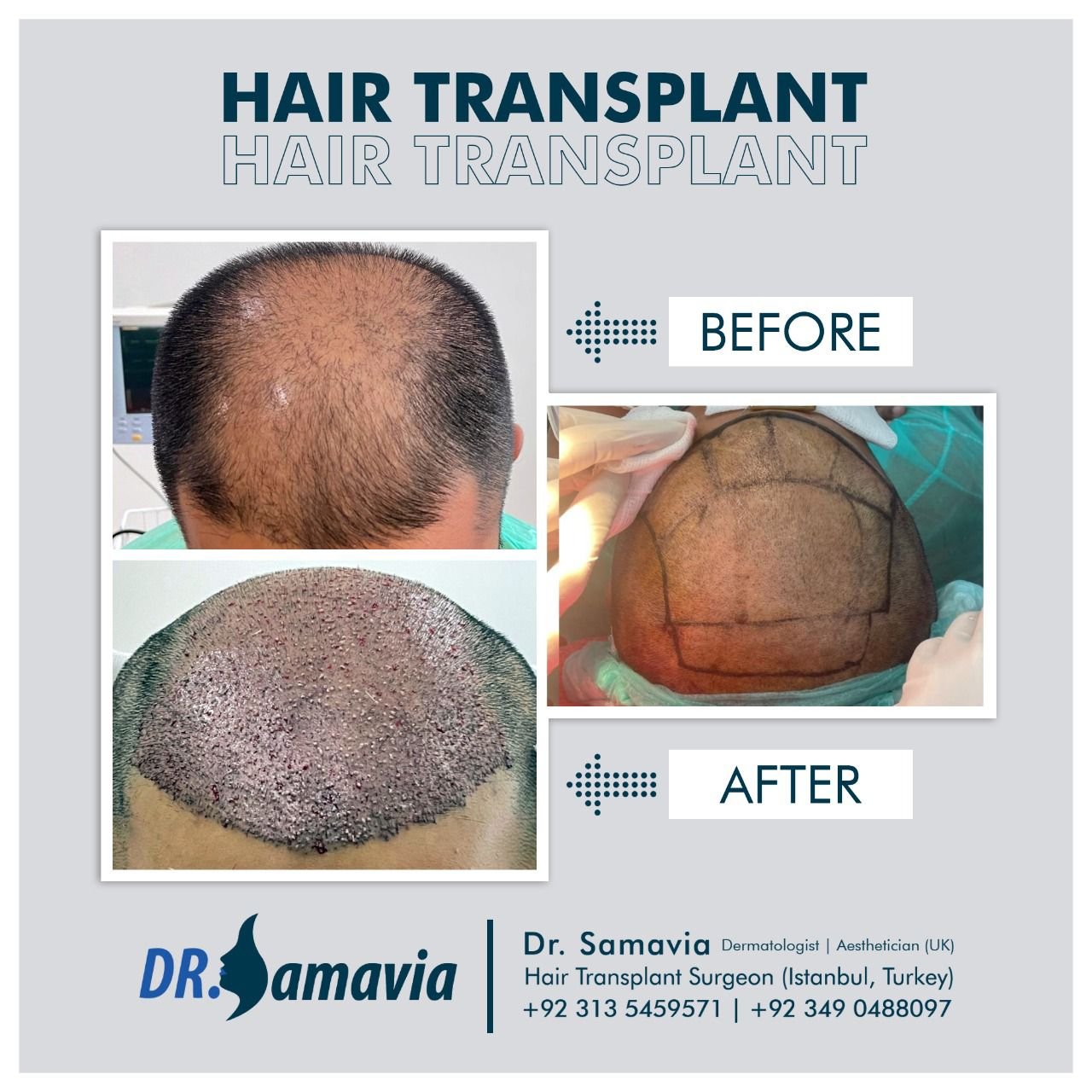
What is Hair Transplant?
A hair transplant is a surgical procedure that redistributes existing hair follicles from a donor region to areas affected by hair loss.
Hair follicles at the back and sides of the scalp are commonly selected because, in many patients with androgenetic alopecia, these follicles are relatively resistant to the hormonal process responsible for pattern hair loss.
Modern hair transplantation uses naturally occurring groups of hairs known as follicular units.
These follicular units can be harvested using two principal techniques:
FUE – Follicular Unit Excision
With FUE, individual follicular units are removed from the donor area using small circular punches.
The grafts are then prepared and implanted into planned recipient areas.
FUE avoids the long linear donor scar associated with strip surgery, but it is not scarless. Each extracted follicular unit creates a small wound that heals with a tiny scar.
FUT – Follicular Unit Transplantation / Strip Surgery
With FUT, a strip of hair-bearing scalp is surgically removed from the donor area.
The strip is divided under magnification into individual follicular-unit grafts, and the donor wound is closed with sutures or staples.
FUT generally leaves a linear donor scar.
Both FUE and FUT are established donor-harvesting methods. The most appropriate option depends on donor characteristics, hairstyle, number of grafts required, previous surgery and the patient's treatment goals.
What Is Hair Transplant Used For?
Hair transplantation is primarily used to restore hair in areas affected by permanent hair loss.
It may be considered for:
- Male pattern baldness
- Female pattern hair loss in selected patients
- Receding hairline
- Temporal recession
- Frontal hair loss
- Crown or vertex baldness
- General pattern thinning
- Selected stable scars
- Previous hair-transplant correction
- Certain stable forms of scarring alopecia after specialist assessment
Hair transplantation can also be performed in selected patients for eyebrow, beard or other hair-restoration concerns.
However, not every form of hair loss is suitable for surgery.
Sudden shedding, alopecia areata, active inflammatory scalp disease, nutritional deficiencies and unstable scarring alopecia may require medical treatment rather than transplantation.
A Personalized Hair Restoration Plan for Better Long-Term Results
Successful hair restoration involves more than simply performing a hair transplant. The best approach depends on the cause and pattern of hair loss, donor-hair availability, scalp condition, medical history, age, existing hair density and the expected progression of future hair loss.
Before recommending treatment, Dr. Samavia assesses each patient individually, reviews their medical and hair-loss history, examines the scalp and donor area, and discusses their concerns and realistic treatment goals. This helps determine whether a hair transplant is appropriate or whether the hair loss should first be treated or stabilised through another approach.
Depending on the diagnosis, an individual hair-restoration plan may include hair transplantation, appropriate medical treatment, correction of nutritional deficiencies when clinically identified, scalp or hair-care guidance, follow-up monitoring, or additional treatment sessions where necessary. Not every patient requires the same combination of treatments.
For patients undergoing a hair transplant, careful planning is particularly important because donor hair is limited and existing non-transplanted hair may continue to thin over time. The treatment plan should therefore consider both the patient's current hair loss and possible future progression rather than focusing only on immediate coverage.
Patients also receive personalised guidance about preparation, postoperative care, scalp care and follow-up. Following the recommended treatment and aftercare plan can support healing and help achieve the best possible outcome for the individual patient, although results and response to treatment vary from person to person.
If you are experiencing hair loss and want to understand whether a hair transplant in Islamabad or another hair-restoration treatment may be suitable for you, you can book a consultation with Dr. Samavia for an individual assessment and treatment plan.
What concerns can it address?
Hair transplantation may improve the appearance of:
- Receding hairlines
- Frontal baldness
- Temple recession
- Crown thinning
- Pattern baldness
- Areas of reduced permanent hair density
- Selected scalp scars
- Certain previous transplant irregularities
The procedure can redistribute existing donor follicles but cannot create an unlimited supply of new hair follicles.
The amount of achievable coverage depends on:
- Donor density
- Hair calibre
- Hair colour
- Hair curl
- Scalp-to-hair colour contrast
- Size of the bald area
- Future hair-loss pattern
- Number of safe donor grafts available
For patients with very advanced hair loss and limited donor supply, full original density may not be achievable.
Potential benefits
Potential benefits of Hair Transplant include:
- Uses the patient's own naturally growing hair follicles.
- Can provide long-lasting hair growth in transplanted areas.
- Allows reconstruction of a receding hairline.
- Can improve coverage of frontal and crown hair loss.
- Follicular units can be positioned according to natural hair direction.
- Modern techniques can produce natural-looking results in appropriately selected patients.
- Both FUE and FUT provide established methods of obtaining donor grafts.
- Can sometimes improve selected scars or previous transplant results.
- Does not require artificial or synthetic hair implantation.
The quality of the result depends strongly on diagnosis, donor management, hairline design, graft survival and surgical expertise rather than simply the name of the transplantation technique.
Limitations and realistic expectations
Hair transplantation redistributes existing follicles; it does not create new ones.
The donor area is a limited resource.
This means the surgeon must plan not only for current baldness but also for possible future hair loss.
Hair transplantation also does not permanently stop androgenetic alopecia.
Hair that was already present in the recipient region but was not transplanted can continue to thin after surgery.
For this reason, medical treatment to slow ongoing hair loss may be discussed when clinically appropriate.
Patients should not expect:
- Restoration of original teenage density
- Unlimited graft availability
- Guaranteed graft survival
- Completely scar-free surgery
- Immediate hair growth
- Identical results between patients
- Permanent protection of existing non-transplanted hair
FUE is frequently marketed as “scarless,” but this is inaccurate. It produces numerous small donor scars.
FUT normally produces a linear scar.
Scar visibility depends on the technique, healing, donor characteristics and hairstyle.
Who may be suitable?
Potential candidates generally require:
- A diagnosis suitable for transplantation
- Adequate permanent donor hair
- Healthy donor scalp
- Ability to grow transplanted follicles in the recipient area
- A reasonably predictable hair-loss pattern
- Realistic expectations
- Sufficient donor supply for long-term planning
Candidates commonly include patients with:
- Male androgenetic alopecia
- Selected female pattern hair loss
- Stable frontal recession
- Crown hair loss
- Selected stable scars
- Previous transplant requiring correction
Age alone does not determine suitability.
However, transplantation in younger patients requires particularly careful planning because future progression of hair loss may be difficult to predict.
Creating an excessively low or dense permanent hairline at a young age may cause problems if surrounding natural hair continues to disappear later.
Who may not be suitable?
Hair transplantation may be unsuitable or require postponement in patients with:
- Inadequate donor hair
- Active scalp infection
- Active inflammatory scalp disease
- Unstable scarring alopecia
- Active alopecia areata
- Unexplained rapid hair loss
- Severe diffuse donor miniaturisation
- Significant uncontrolled medical illness
- Significant bleeding disorders
- Poor wound healing
- Unrealistic expectations
Some women with diffuse hair thinning may have reduced donor density as well as thinning in the recipient area, which can limit suitability.
A patient who has lost a very large amount of hair may also lack sufficient donor follicles to reproduce the desired density.
Proper diagnosis and donor assessment are therefore essential before surgery.
How to prepare
Before Hair Transplant surgery, provide the surgical team with a complete medical history.
Tell your clinician about:
- Prescription medicines
- Blood-thinning medicines
- Vitamins and supplements
- Allergies
- Previous scalp surgery
- Previous hair transplantation
- Hair-loss medicines
- Bleeding disorders
- Diabetes
- Smoking
- Previous anaesthetic reactions
- Medical conditions
The assessment may include:
- Hair-loss diagnosis
- Donor density
- Hair calibre
- Degree of miniaturisation
- Scalp examination
- Hairline planning
- Estimated graft requirement
- Future hair-loss risk
Baseline photographs are commonly useful for treatment planning and follow-up.
Follow the clinic's instructions concerning hair washing, smoking, alcohol, food and medication before surgery.
Do not stop aspirin, anticoagulants or another prescribed medicine unless the prescribing clinician or surgical team specifically instructs you to do so.
How the procedure works
1. Consultation and diagnosis
The cause and pattern of hair loss are assessed and suitability for surgery is determined.
2. Donor assessment
The surgeon evaluates density, hair characteristics and the amount of hair that can safely be harvested.
3. Hairline and recipient planning
The hairline, graft distribution and treatment areas are designed according to facial proportions and expected future hair loss.
4. Local anaesthesia
The donor and recipient areas are numbed using local anaesthetic.
5. Donor harvesting
Follicular units are harvested using either:
- FUE individual extraction, or
- FUT/linear strip excision.
6. Graft preparation
The follicular-unit grafts are inspected, organised and maintained appropriately before implantation.
7. Recipient-site preparation
Small recipient sites are created according to the planned direction, angle and distribution of the transplanted hairs.
8. Graft implantation
The follicular units are carefully inserted into the planned recipient areas.
Different implantation methods may be used, including forceps-based placement or specialised implanter devices.
9. Final assessment
The donor and recipient areas are examined, and appropriate dressings may be applied when required.
10. Aftercare
The patient receives instructions regarding washing, sleeping, exercise, medication and protection of the grafts.
Results and treatment timeline
Hair-transplant results develop gradually.
First few days
Common temporary changes include:
- Redness
- Swelling
- Tenderness
- Small crusts around grafts
- Donor-area discomfort
The transplanted grafts require careful handling during the early recovery period.
First 2 weeks
Crusting and redness generally improve.
Patients should follow instructions carefully because transplanted grafts are particularly vulnerable during early healing.
Approximately 2 to 8 weeks
Many transplanted hair shafts shed.
This is commonly expected and does not automatically mean that the follicles themselves have been lost.
Around 3 to 4 months
New transplanted hair may begin to appear.
Early growth can initially be fine and uneven.
Around 6 to 9 months
A more noticeable improvement in coverage commonly develops.
Around 10 to 18 months
The result continues to mature, with improvements in hair length, calibre and overall appearance.
The crown can sometimes take longer to mature than the frontal scalp.
Existing non-transplanted hair may continue to thin throughout this period and beyond.
Risks and side effects
Hair transplantation is surgery and has potential risks.
Common temporary effects include:
- Scalp pain
- Tenderness
- Swelling
- Redness
- Crusting
- Itching
- Temporary numbness
- Mild bleeding
- Donor-area tightness
Other potential complications include:
- Infection
- Significant bleeding
- Reaction to local anaesthesia
- Folliculitis
- Cysts
- Persistent numbness
- Temporary shedding of surrounding hair
- Poor graft survival
- Uneven growth
- Unnatural hair direction
- Hairline irregularity
- Pigmentation changes
- Visible scarring
- Excessive donor-area thinning
- Widened FUT scar
- Overharvesting with FUE
- Unsatisfactory density or cosmetic outcome
Hair transplantation cannot guarantee that every transplanted graft will survive.
Good surgical planning should prioritise safe donor management rather than simply attempting to extract the maximum possible number of grafts.
Recovery and aftercare
The first two weeks after Hair Transplant surgery are particularly important.
Follow the surgical team's individual instructions.
Patients may be advised to:
- Avoid touching or scratching newly transplanted grafts.
- Sleep with the head elevated during the early recovery period.
- Use prescribed sprays or medications.
- Wash the scalp according to the supplied technique.
- Avoid picking crusts.
- Avoid strenuous exercise temporarily.
- Avoid swimming until appropriately healed.
- Avoid direct trauma to the recipient area.
- Protect the scalp from excessive sun exposure.
- Attend scheduled follow-up appointments.
The NHS advises that grafts require particular care during the first two weeks after transplantation.
Depending on the procedure, many patients may require approximately 1 to 2 weeks before returning comfortably to normal social or work activities.
Contact the clinic if you experience:
- Increasing or severe pain
- Significant bleeding
- Spreading redness
- Pus or discharge
- Fever
- Severe swelling
- Another unexpected symptom
Alternatives and comparisons
The best treatment depends on the diagnosis, degree of hair loss and donor availability.
Alternatives may include:
- Observation
- Topical minoxidil
- Oral medical treatment when appropriate
- PRP Hair Treatment
- PRF Hair Treatment
- Laser Hair Growth Treatment
- Hair Booster Injection
- Mesotherapy
- Scalp Micropigmentation
- Cosmetic hair fibres
- Hair systems
FUE vs FUT Hair Transplant
FUE removes individual follicular units using small circular punches.
Advantages may include avoidance of a long linear donor scar and greater flexibility for patients who prefer shorter hairstyles.
However, FUE creates many small scars and excessive extraction can reduce visible donor density.
FUT removes a strip of donor scalp from which follicular units are dissected.
It produces a linear scar but can remain an appropriate technique for selected patients, particularly where donor management and graft requirements favour strip harvesting.
Neither method is automatically superior for every patient.
Hair Transplant vs DHI
Hair transplantation describes the overall process of transferring follicles.
DHI generally refers to an implantation approach using an implanter device.
Many procedures marketed as DHI use FUE to harvest the grafts before implantation.
DHI is therefore not necessarily an alternative to FUE; FUE may describe the harvesting stage while an implanter describes the placement stage.
Hair Transplant vs PRP
Hair transplantation surgically moves real follicles into areas of permanent hair loss.
PRP uses platelet-rich plasma prepared from the patient's blood and injected into areas containing existing follicles.
PRP does not replace permanently lost follicles and cannot provide the same type of restoration as transplantation in a completely bald area.
Hair Transplant vs Scalp Micropigmentation
Hair transplantation produces actual growing transplanted hairs.
Scalp Micropigmentation uses pigment to create the visual appearance of follicles or increased density.
SMP does not produce actual hair growth.
What affects the cost?
The cost of Hair Transplant surgery depends on factors including:
- Number of grafts required
- FUE versus FUT harvesting
- Size of the treatment area
- Degree of hair loss
- Donor density
- Hair characteristics
- Complexity of hairline reconstruction
- Previous hair transplantation
- Scar correction
- Length of surgery
- Surgical team and clinician expertise
- Number of sessions
- Postoperative follow-up
An accurate graft estimate should be made after examination rather than solely from photographs or a patient's requested graft number.
A larger number of grafts is not automatically better.
Donor follicles are limited, and excessive harvesting can permanently compromise the appearance of the donor region.
Long-term donor preservation should therefore be part of every treatment plan.
Patient experiences
Reviews describe individual experiences and do not predict another patient's result.
I had a wonderful experience consulting with Dr. Samaviya Ejaz. She is an incredibly impressive and professional dermatologist. Her clinic is beautiful and has a calming atmosphere.
Umar Shah
Read on GoogleI had my hair fall consultation with Dr Samavia. She thoroughly explained the treatment. After PRF sessions my hair fall stopped and density improved. Highly recommend.
Moneeb Mumtaz
Read on GoogleI have had a few treatments at this clinic and I am happy with the outcomes. Dr. Samavia and her team are kind, professional, and trustworthy.
Sheikh Yousuf Kareem
Read on GoogleVisit Dr Samavia at Facetime Clinic
Use the verified Google profile for clinic directions, business details and linked patient reviews.
Clinical references
- Hair TransplantNHS · accessed 29 August 2026
- A Hair Transplant Can Give You Permanent, Natural-Looking ResultsAmerican Academy of Dermatology · accessed 29 August 2026
- Surgical Treatments for Hair LossInternational Society of Hair Restoration Surgery (ISHRS) · accessed 29 August 2026
- Hair Transplantation: State of the ArtDermatologic Surgery / PubMed · accessed 29 August 2026
- Hair Transplantation: Basic OverviewJournal of the American Academy of Dermatology / PubMed · accessed 29 August 2026
Hair Transplant FAQs
Is a Hair Transplant permanent?
Successfully transplanted follicles are usually selected from donor areas that are relatively resistant to androgenetic hair loss and are intended to continue producing hair long term. However, existing non-transplanted hair can continue to thin. A hair transplant should therefore be considered a long-term redistribution of donor follicles rather than a permanent cure for all future hair loss.
How long does it take to see Hair Transplant results?
Transplanted hair commonly sheds during the first several weeks. New growth may begin at approximately three to four months. More visible improvement develops over six to nine months, while the overall result can continue maturing for approximately 10 to 18 months.
How many grafts do I need for a Hair Transplant?
The number of grafts depends on the area of hair loss, donor density, hair calibre, desired coverage, previous surgery and anticipated future hair loss. There is no correct universal graft number. The scalp and donor area should be assessed before an estimate is provided.
Which is better, FUE or FUT Hair Transplant?
Both FUE and FUT are established methods of harvesting follicular units. FUE avoids a long linear scar but leaves many small scars, while FUT leaves a linear donor scar. The better option depends on donor characteristics, hairstyle, graft requirements, previous procedures and long-term donor management.
Does Hair Transplant surgery leave scars?
Yes. All hair-transplant surgery creates some degree of scarring. FUE normally leaves numerous small circular donor scars, whereas FUT produces a linear scar where the strip was removed. Scar visibility varies according to technique, healing, hair length and individual scar formation.
Can transplanted hair fall out again?
The transplanted hair shafts commonly shed several weeks after surgery before new growth begins, which is usually part of the normal postoperative cycle. Successfully established donor follicles are intended to provide long-term growth. However, surrounding non-transplanted hair can continue to thin, and graft survival is never guaranteed to be 100%.
Other Hair Procedures guides
Book a consultation in Islamabad to review suitability, alternatives, expected recovery and individual risks.