
LED Light Therapy in Islamabad
LED Light Therapy is a non-invasive aesthetic treatment that uses specific wavelengths of visible or near-infrared light to expose the skin without intentionally removing or burning its surface. Different wavelengths are used for different treatment goals. Red or near-infrared light is commonly used for skin rejuvenation and photobiomodulation, while blue light may be used as part of treatment for mild-to-moderate inflammatory acne.
LED therapy generally requires a series of treatments rather than a single session. Evidence suggests potential benefits for selected concerns, but results depend on the wavelength, device, dose, treatment frequency and underlying skin condition. LED therapy should usually be considered an adjunct rather than a replacement for established medical treatment when a diagnosed skin condition is present.
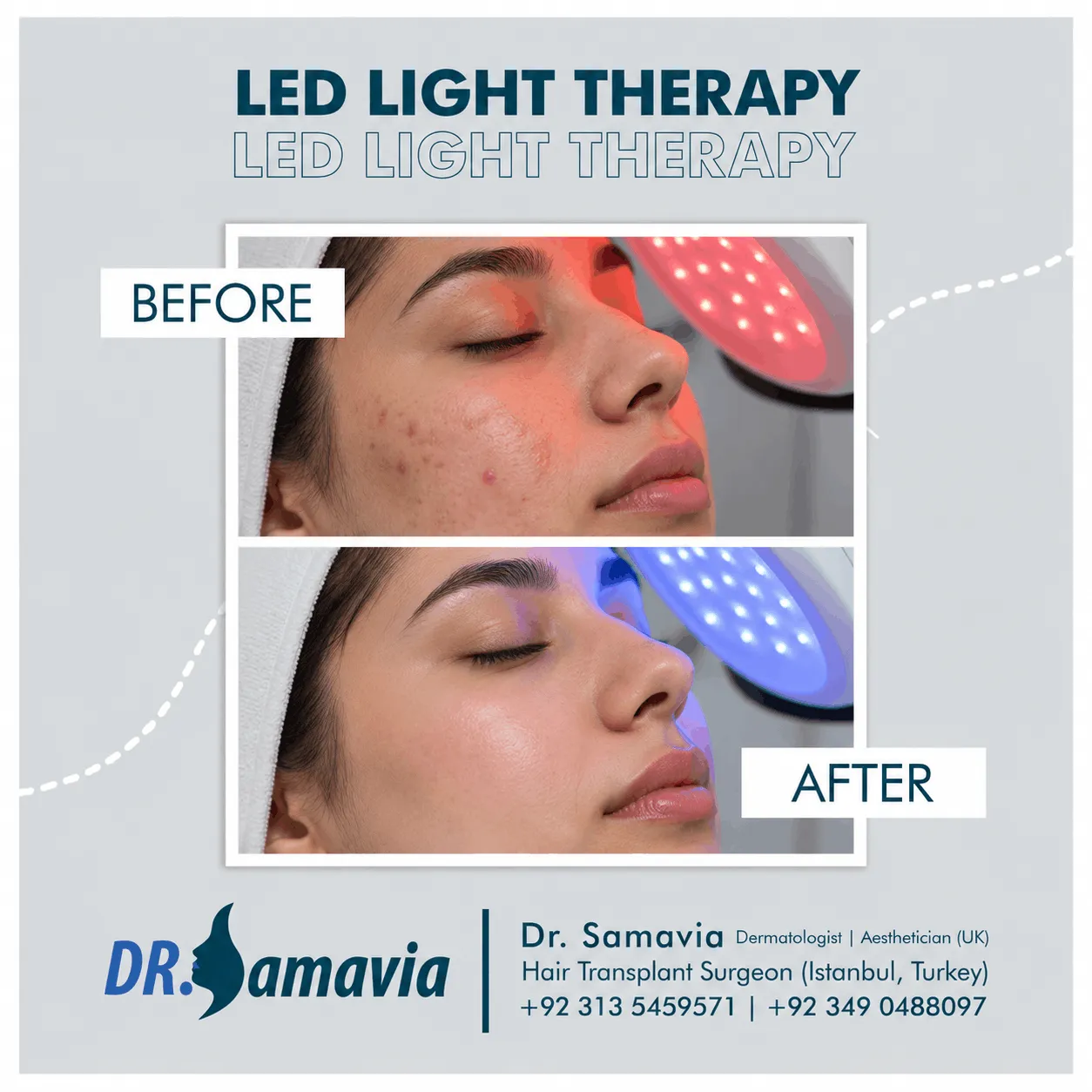
What is LED Light Therapy?
LED (Light-Emitting Diode) Therapy uses light at selected wavelengths to interact with biological processes within the skin.
It is sometimes described as photobiomodulation, particularly when red or near-infrared light is used.
Unlike ablative or resurfacing lasers, standard LED therapy does not intentionally:
- Cut the skin
- Remove the epidermis
- Create microscopic wounds
- Produce significant thermal destruction
Different wavelengths have different proposed biological effects.
Red Light
Red-light LED therapy is commonly used for cosmetic concerns such as:
- Fine lines
- Early signs of photoageing
- Skin texture
- Redness
- General skin rejuvenation
Red light is being studied for its effects on cellular activity and processes related to inflammation and tissue repair.
Near-Infrared Light
Near-infrared wavelengths penetrate differently from visible red light and are often incorporated into photobiomodulation devices.
They may be used alone or together with red light depending on the device.
Blue Light
Blue light is primarily used in acne treatment.
Certain wavelengths can interact with molecules produced by Cutibacterium acnes, contributing to antibacterial effects.
Visible blue light may therefore help selected inflammatory acne lesions.
However, it does not effectively treat every type of acne.
Other LED Colours
Some devices also provide:
- Amber
- Yellow
- Green
- Combination wavelengths
Evidence varies substantially between colours, devices and claimed indications.
The presence of multiple colours does not automatically mean that every colour has proven clinical benefits.
What Is LED Light Therapy Used For?
Depending on the wavelength and device, LED Light Therapy may be considered for:
- Mild inflammatory acne
- Facial redness
- Fine lines
- Early wrinkles
- Rough-feeling skin
- Mild uneven-looking skin tone
- General skin rejuvenation
- Recovery after selected aesthetic procedures
- General skin-maintenance programmes
Red light is commonly used as an adjunctive rejuvenation treatment.
Blue or combined red-and-blue LED devices may be used for selected acne concerns.
The American Academy of Dermatology notes that visible blue, red and combined blue-red light can help treat inflammatory pimples, but visible-light treatment does not effectively treat blackheads, whiteheads, cysts or nodules.
A Personalized Approach to LED Light Therapy
Skin concerns such as acne, redness, early signs of ageing and uneven texture can have different underlying causes, so LED Light Therapy should be selected according to the patient's specific skin condition, treatment goal, skin type and the wavelength or device being used rather than applying the same light protocol to everyone.
Before recommending LED Light Therapy, Dr. Samavia assesses each patient individually, considering the primary skin concern, current skin condition, medical history, medications, photosensitivity, previous aesthetic procedures, current acne or skincare treatments, skin tone and realistic expectations.
The first priority is to determine whether LED therapy is appropriate for the patient's concern and whether it should be used alone or as part of a broader treatment plan. For example, blue-light therapy may be considered for selected inflammatory acne lesions, while red or near-infrared wavelengths may be used for photobiomodulation, early skin-ageing concerns or selected recovery protocols.
Different LED wavelengths and devices are not interchangeable. Treatment planning therefore considers the wavelength, treatment dose, exposure duration, treatment frequency, device specifications and intended clinical or cosmetic purpose.
If LED Light Therapy is considered appropriate, Dr. Samavia develops an individual treatment plan rather than relying on a universal number of sessions. Depending on the diagnosis, the wider plan may also include medical-grade skincare, acne treatment, topical medication, chemical peels, microneedling, laser treatment, skin boosters or another clinically appropriate procedure.
LED therapy is often most useful as an adjunctive treatment. Patients with moderate or severe acne, significant pigmentation, persistent redness or another diagnosed skin disorder may require established medical treatment rather than LED therapy alone.
Patients should also understand that LED Light Therapy generally produces gradual and relatively modest changes rather than dramatic correction after a single session. It does not permanently remove wrinkles or pigmentation, eliminate acne scars, provide surgical skin tightening or reproduce the results of laser resurfacing.
Monitoring Treatment Progress
LED Light Therapy usually requires repeated treatments, so results should be evaluated over an appropriate period rather than immediately after the first session.
Where appropriate, baseline clinical photographs and assessment of acne activity, redness, skin texture or other treatment-specific findings may be used to document the patient's starting condition and monitor progress.
Dr. Samavia reviews treatment response during follow-up to determine whether the LED protocol should be continued, modified or combined with another clinically appropriate treatment.
For acne patients, monitoring may include changes in inflammatory lesions while also assessing whether blackheads, whiteheads, cystic acne or nodules require a different treatment approach. For rejuvenation patients, changes in skin texture, fine lines, redness and overall appearance may be assessed gradually over several weeks.
Because treatment outcomes depend on the device, wavelength, dose, treatment frequency, underlying skin condition and individual biological response, there is no single session schedule or degree of improvement that can be guaranteed for every patient.
Patients also receive personalised guidance regarding skincare, sun protection, photosensitising medications, eye protection where required and how LED therapy should be coordinated with other aesthetic procedures. Increasing treatment duration or frequency beyond the recommended protocol should not be assumed to produce faster or better results.
If you are considering LED Light Therapy in Islamabad, you can book a consultation with Dr. Samavia for an individual skin assessment and personalised treatment plan.
What concerns can it address?
Mild inflammatory acne
Blue LED therapy may help reduce selected inflammatory acne lesions.
A 2025 systematic review and meta-analysis of at-home LED devices found evidence that red and/or blue LED devices may improve mild-to-moderate acne.
However, LED should not automatically replace established acne medications.
Fine lines and early wrinkles
Red-light photobiomodulation has been investigated for visible signs of skin ageing.
Some studies report improvement in:
- Fine lines
- Skin smoothness
- Roughness
- Overall skin appearance
Changes tend to be gradual and generally require repeated exposure.
Redness
Red light may help improve the appearance of redness in selected patients.
Persistent redness caused by rosacea or another medical skin condition should nevertheless be diagnosed before cosmetic treatment.
Skin texture
Repeated red-light treatment may provide modest improvements in skin smoothness or texture.
It does not provide the same degree of resurfacing as:
- Fractional laser
- Chemical peeling
- Microneedling
- Ablative resurfacing
Post-procedure recovery
LED photobiomodulation is sometimes incorporated after selected aesthetic treatments with the aim of supporting recovery and reducing temporary inflammation.
Whether this is appropriate depends on the procedure performed and the LED protocol being used.
Potential benefits
Potential benefits of LED Light Therapy include:
- Non-invasive treatment
- No injections
- No surgical incisions
- Usually painless
- Usually no downtime
- Can be used over relatively broad treatment areas
- Red light may provide modest improvement in selected signs of skin ageing
- Blue light may help selected inflammatory acne lesions
- Can sometimes complement medical skincare or other aesthetic treatments
- Does not intentionally remove the skin surface
The American Academy of Dermatology reports that some studies show subtle-to-noticeable improvements in fine lines, roughness, discoloration and other signs of ageing after repeated red-light treatment.
Results should nevertheless remain realistic because different studies use different wavelengths, devices, treatment times and doses.
Limitations and realistic expectations
LED therapy should not be marketed as a universal skin treatment.
It cannot reliably:
- Permanently remove wrinkles
- Provide surgical skin tightening
- Permanently remove pigmentation
- Cure all acne
- Remove acne scars
- Permanently shrink pores
- Replace dermal filler
- Replace Botox
- Produce laser-resurfacing results
- Guarantee visible improvement after one session
For acne, visible LED light has important limitations.
According to the American Academy of Dermatology, visible-light treatment may improve pimples but is not effective for:
- Blackheads
- Whiteheads
- Acne cysts
- Acne nodules
Moderate or severe acne may therefore require topical or oral medical treatment.
Evidence for red-light rejuvenation is promising but also variable.
Important unanswered questions include:
- Ideal wavelength
- Ideal dose
- Ideal session duration
- Ideal number of treatments
- Long-term treatment frequency
- Long-term effects of repeated exposure
Patients should therefore be cautious about claims such as:
- “Instant collagen regeneration”
- “Permanent facelift with LED”
- “Acne cured after one session”
- “Permanent pigmentation removal”
- “Every LED colour has proven benefits”
- “FDA cleared means guaranteed effectiveness”
These claims are not justified by current evidence.
LED Light Therapy and FDA Clearance
Some LED devices have received FDA 510(k) clearance for specific indications.
For example, certain devices are cleared for:
- Treatment of wrinkles using red or red-plus-infrared light
- Mild-to-moderate inflammatory acne using blue light
- Selected combined-light protocols
FDA clearance applies to the specific device and indication.
It does not mean every LED mask, panel or facial machine is proven to produce the same result.
Patients and clinics should also distinguish between:
FDA-cleared and FDA-approved.
For these types of medical devices, 510(k) clearance is commonly the relevant regulatory pathway.
A claim that a generic LED facial is “FDA approved” should therefore not be made unless that exact regulatory status genuinely applies.
Who may be suitable?
LED Light Therapy may be considered for selected adults with:
- Mild inflammatory acne
- Early signs of skin ageing
- Fine lines
- Mild rough texture
- Mild facial redness
- General skin-maintenance goals
- Preference for a non-invasive treatment
- Realistic expectations regarding gradual improvement
Suitability depends on:
- Skin condition
- Treatment goal
- Wavelength
- Device
- Medical history
- Current medications
- Photosensitivity
- Previous procedures
A patient with significant acne, pigmentation or inflammatory skin disease should have the condition properly assessed rather than relying only on LED treatment.
Who may not be suitable?
LED treatment may need additional assessment or modification in patients with:
- Known photosensitivity
- Certain photosensitive medical conditions
- Medications that increase sensitivity to light
- Active significant skin disease requiring diagnosis
- Severe inflammatory acne requiring systemic treatment
- Previous unusual reaction to light-based procedures
Patients should disclose medications including those known to cause photosensitivity.
Pregnancy and breastfeeding should also be discussed before elective treatment, particularly when LED is being combined with active topical products or another procedure.
Darker skin tones
The American Academy of Dermatology notes that people with darker skin tones can be more sensitive to visible light and may be more susceptible to hyperpigmentation under certain circumstances.
Appropriate assessment and device use are therefore important rather than assuming that every visible-light protocol is risk-free for every skin tone.
How to prepare
Before LED Light Therapy, tell your clinician or treatment provider about:
- Prescription medicines
- Photosensitising medication
- Supplements
- Current acne treatment
- Retinoids
- Recent chemical peels
- Laser treatment
- Microneedling
- Active skin conditions
- Photosensitivity
- Previous reactions to light treatment
- Pregnancy or breastfeeding
- Medical conditions
The skin is commonly cleaned before treatment so that:
- Makeup
- Sunscreen
- Heavy creams
- Surface oils
do not unnecessarily interfere with the treatment protocol.
Certain LED treatments are combined with topical products, but only products considered appropriate for the specific device should be applied.
How the procedure works
1. Skin assessment
The patient's concern is identified and the skin is assessed.
2. Wavelength selection
The appropriate wavelength or combination is selected.
For example:
Red light:
May be used for selected rejuvenation or photobiomodulation goals.
Blue light:
May be used for mild-to-moderate inflammatory acne.
Red + blue:
May combine different biological effects in selected acne protocols.
3. Skin cleansing
Makeup and surface products are removed when required.
4. Eye protection
Appropriate eye protection should be used whenever recommended by the device manufacturer or treatment protocol.
5. LED exposure
The LED panel, mask or another device is positioned at the appropriate distance from the skin.
Light is delivered for a predetermined period.
Treatment should follow the recommended:
- Wavelength
- Exposure time
- Distance
- Treatment frequency
for the specific device.
6. Completion
The skin is reassessed after exposure.
7. Skincare
Appropriate moisturiser and sunscreen may be applied depending on the treatment.
No needles or deliberate skin injury are normally involved in standard LED treatment.
Results and treatment timeline
LED Light Therapy usually requires repeated sessions.
Immediately after treatment
Most patients experience no major visible change.
The skin may occasionally feel:
- Warm
- Slightly sensitive
- Mildly red
First several weeks
Subtle changes may begin to develop with consistent treatment.
After a course of treatment
Studies evaluating red-light rejuvenation frequently involve multiple treatments over several weeks.
The AAD cites research in which patients received eight facial LED treatments over four weeks, with many reporting improvement in skin smoothness, redness and pigmentation.
This should not be interpreted as a universal protocol for every device.
Acne treatment
Acne studies also generally involve repeated treatment.
A 2025 systematic review and meta-analysis found that at-home red and blue LED devices can reduce inflammatory and non-inflammatory acne lesion counts, but protocols varied significantly.
Medical acne treatment may still be needed.
Maintenance
Some patients choose ongoing or maintenance LED treatment after completing an initial course.
There is currently no universally accepted maintenance schedule.
Risks and side effects
LED therapy is generally well tolerated in the short term.
Potential temporary effects include:
- Mild redness
- Warmth
- Temporary irritation
- Mild discomfort
- Dryness
- Headache or eye discomfort in susceptible patients
Photosensitivity
Patients with photosensitive conditions or medicines may react differently to light exposure.
A medication review may therefore be appropriate.
Pigmentation changes
Visible light may contribute to pigmentation in susceptible skin.
The AAD particularly advises people with darker skin tones to obtain appropriate dermatological advice before using red-light devices because visible light can trigger more persistent hyperpigmentation in some individuals.
Eye safety
Some LED devices require protective eyewear.
Device-specific eye-protection instructions should always be followed.
Do not substitute ordinary sunglasses when medical protective eyewear is specifically required.
Long-term safety
Short-term red-light treatment appears to have a favourable safety profile.
Unlike ultraviolet radiation, red LED therapy does not use UV wavelengths known to cause skin cancer.
However, the AAD notes that the long-term effects of repeated red-light treatment are not yet fully understood.
Recovery and aftercare
LED therapy usually requires no conventional recovery period.
Most patients can immediately resume normal activities.
General aftercare may include:
- Continue gentle skincare.
- Use appropriate moisturiser.
- Use broad-spectrum sunscreen.
- Avoid unnecessary irritation if the skin feels sensitive.
- Continue prescribed acne treatment unless advised otherwise.
- Follow device-specific instructions.
- Do not dramatically increase treatment duration or frequency in an attempt to achieve faster results.
More exposure does not necessarily mean better results.
If LED treatment is performed after another procedure, follow the aftercare instructions for the primary procedure, which may be substantially more important than LED-specific aftercare.
Contact the clinic if you develop:
- Persistent significant redness
- Burning
- Rash
- Significant pigmentation changes
- Eye symptoms
- Another unexpected reaction
Alternatives and comparisons
The best alternative depends on the treatment goal.
For Acne
Options may include:
- Benzoyl peroxide
- Topical retinoids
- Azelaic acid
- Appropriate antibiotics
- Hormonal treatment in selected patients
- Oral isotretinoin for appropriate severe acne
- Chemical peels
- Other light or laser procedures
LED may complement these treatments but does not automatically replace them.
For Fine Lines and Skin Rejuvenation
Alternatives may include:
- Medical skincare
- Retinoid-based treatment
- Chemical peels
- Microneedling
- Radiofrequency microneedling
- Laser resurfacing
- Skin boosters
- Botulinum toxin
- Dermal fillers
LED vs Laser
LED therapy uses relatively low-intensity light and does not normally intentionally damage the skin.
Laser treatments use concentrated light with specific optical characteristics and may create substantially stronger effects.
Depending on the laser, treatment can address:
- Pigmentation
- Acne scars
- Blood vessels
- Hair
- Wrinkles
- Skin resurfacing
Laser procedures may provide greater correction but can also involve greater downtime and risk.
LED vs Hydrafacial
Hydrafacial physically:
- Cleanses
- Exfoliates
- Extracts superficial debris
- Hydrates the skin
LED uses light energy and does not perform extraction or mechanical exfoliation.
Some facial protocols combine the two treatments.
LED vs Chemical Peel
A chemical peel uses a chemical solution to create controlled exfoliation.
LED does not intentionally peel or remove the skin.
The treatments therefore produce very different effects.
LED vs Photodynamic Therapy
Standard LED therapy and photodynamic therapy (PDT) should not be confused.
PDT usually involves applying a photosensitising medication to the skin before exposure to an appropriate light source.
This creates a substantially different biological reaction and has different:
- Indications
- Risks
- Downtime
- Medical supervision requirements
What affects the cost?
The cost of LED Light Therapy can depend on:
- Device used
- Wavelengths available
- Duration of treatment
- Number of sessions
- Full-face versus targeted treatment
- Acne versus rejuvenation protocol
- Whether LED is combined with another procedure
- Clinic-based versus home-use treatment plan
LED is also frequently offered as an additional step after:
- Hydrafacial
- Facial treatment
- Microneedling
- Selected laser procedures
Adding LED does not automatically improve the outcome of every procedure.
The treatment should have a clear clinical or cosmetic purpose rather than being added simply because multiple light colours are available.
Patient experiences
Reviews describe individual experiences and do not predict another patient's result.
I had a wonderful experience consulting with Dr. Samaviya Ejaz. She is an incredibly impressive and professional dermatologist. Her clinic is beautiful and has a calming atmosphere.
Umar Shah
Read on GoogleI had my hair fall consultation with Dr Samavia. She thoroughly explained the treatment. After PRF sessions my hair fall stopped and density improved. Highly recommend.
Moneeb Mumtaz
Read on GoogleI have had a few treatments at this clinic and I am happy with the outcomes. Dr. Samavia and her team are kind, professional, and trustworthy.
Sheikh Yousuf Kareem
Read on GoogleVisit Dr Samavia at Facetime Clinic
Use the verified Google profile for clinic directions, business details and linked patient reviews.
Clinical references
- Is Red Light Therapy Right for Your Skin?American Academy of Dermatology · accessed 30 August 2026
- Lasers and Lights: How Well Do They Treat Acne?American Academy of Dermatology · accessed 30 August 2026
- At-Home LED Devices for the Treatment of Acne Vulgaris: A Systematic Review and Meta-AnalysisJAMA Dermatology / PubMed · accessed 30 August 2026
- Over-the-Counter Powered Light-Based Device for Acne — Product ClassificationU.S. Food and Drug Administration · accessed 30 August 2026
- LED Light Therapy Device — 510(k) Indications for UseU.S. Food and Drug Administration · accessed 30 August 2026
- Visible Light: Cutaneous Effects and PhotobiomodulationJournal of the American Academy of Dermatology · referenced by AAD · accessed 30 August 2026
LED Light Therapy FAQs
What does LED Light Therapy do?
LED Light Therapy exposes the skin to selected wavelengths of visible or near-infrared light. Red light is commonly used for photobiomodulation and selected signs of skin ageing, while blue light may help mild-to-moderate inflammatory acne. Its effects are gradual and depend on the wavelength, device and treatment protocol.
Is LED Light Therapy good for acne?
Blue, red or combined LED therapy may improve selected inflammatory acne lesions. Current evidence supports a potential benefit for mild-to-moderate acne, but LED rarely clears every type of acne by itself. Blackheads, whiteheads, cysts and nodules may require other established treatments.
Does red LED light remove wrinkles?
Red-light therapy may produce subtle-to-noticeable improvement in selected fine lines and other signs of ageing after repeated treatment. It does not erase deep wrinkles or provide the same correction as botulinum toxin, fillers, resurfacing lasers or surgery.
How many LED sessions are needed?
There is no universal treatment schedule. Clinical studies and commercial devices use different wavelengths, doses and frequencies. Many protocols involve multiple treatments each week or a series over several weeks. The schedule should follow the specific device and treatment goal rather than using one standard number for every patient.
Does LED Light Therapy have downtime?
Standard LED treatment usually has little or no downtime. Some patients may develop temporary warmth, mild redness or irritation. If LED is combined with microneedling, laser, chemical peeling or another procedure, recovery is determined mainly by that additional treatment.
Other Face Treatments guides
Book a consultation in Islamabad to review suitability, alternatives, expected recovery and individual risks.