
Mesotherapy in Islamabad
Mesotherapy is a minimally invasive technique in which small quantities of selected substances are injected into the superficial or middle layers of the skin. Depending on the treatment goal, formulations may include medicines, vitamins, amino acids, hyaluronic acid, antioxidants or other compounds.
Mesotherapy is used in aesthetic practice for concerns such as skin quality, pigmentation and hair thinning, but it is not one standardized treatment. The ingredients, injection depth, dose and treatment schedule can differ substantially between protocols. Evidence also varies according to the condition being treated, so assessment and appropriate product selection are important before treatment.
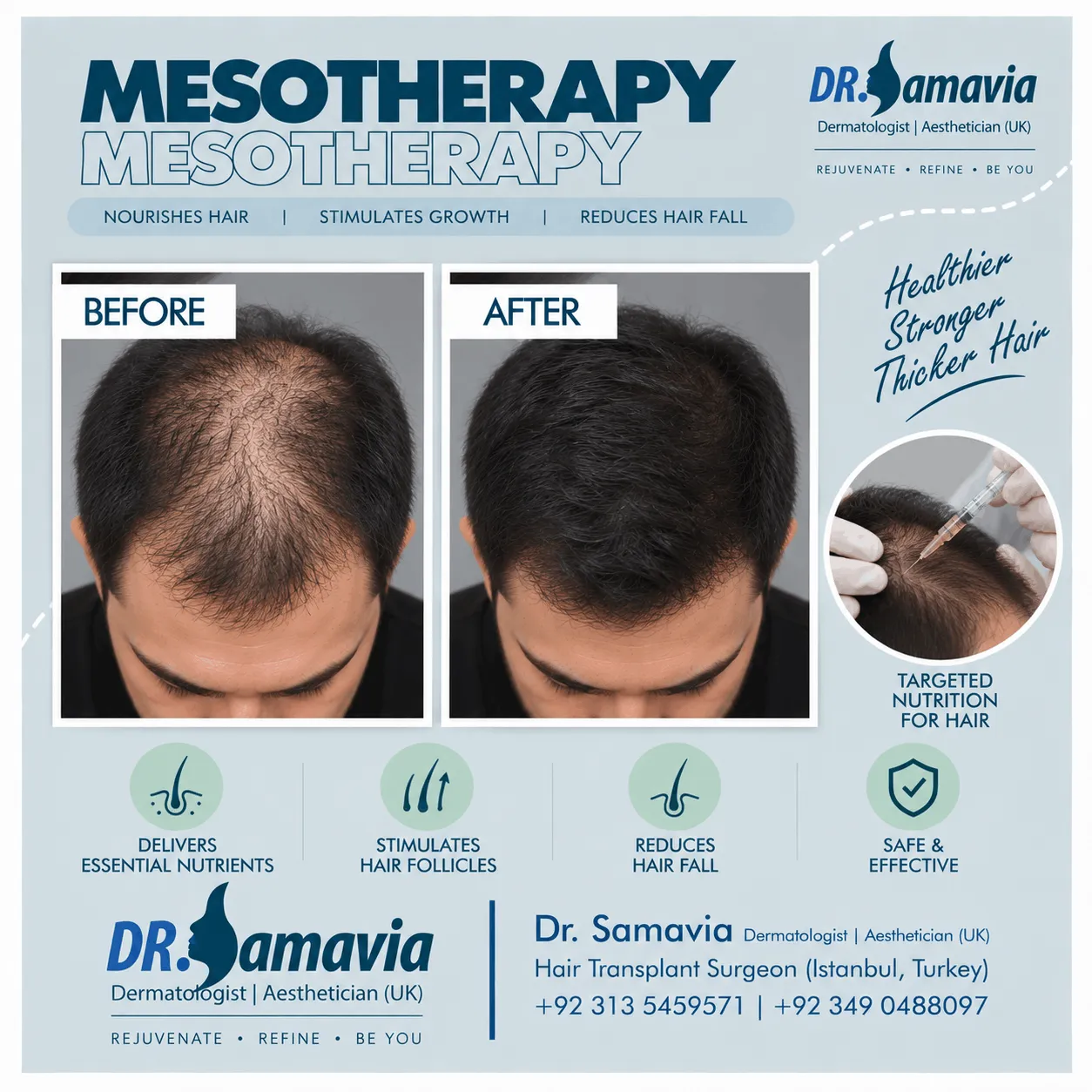
What is Mesotherapy?
Mesotherapy is an injection technique in which small amounts of selected therapeutic or cosmetic substances are delivered directly into or just beneath the skin.
The technique was originally developed for medical purposes and has since been adopted in aesthetic medicine for a wide variety of indications.
Rather than describing one specific medication, the term "mesotherapy" refers primarily to the method of delivering substances through multiple small injections.
Depending on the treatment objective, a mesotherapy formulation may contain:
- Hyaluronic acid
- Vitamins
- Amino acids
- Antioxidants
- Certain medicines
- Growth-related compounds
- Other clinician-selected injectable ingredients
Different formulations have different evidence, benefits, contraindications and risks.
For this reason, patients should be informed exactly what product is being injected rather than being offered "mesotherapy" as though every treatment were identical.
What Is Mesotherapy Used For?
Mesotherapy has been investigated and used in aesthetic medicine for several purposes.
Depending on the formulation and clinical assessment, it may be discussed for:
- Dull or dehydrated-looking skin
- Uneven skin texture
- Selected pigmentation concerns
- Melasma in selected patients
- Skin rejuvenation
- Fine superficial lines
- Hair thinning
- Male or female pattern hair loss
- Overall scalp and hair-quality concerns
Some clinics also market mesotherapy for localised fat reduction or cellulite.
However, evidence and safety vary considerably depending on the substances injected, and mesotherapy should not be assumed to be effective for every advertised indication.
Treatment should therefore be selected according to the specific diagnosis rather than simply choosing mesotherapy as a general-purpose cosmetic procedure.
A Personalized Approach to Mesotherapy
Mesotherapy is not one standardized treatment, and the appropriate approach depends on the condition being treated, the product being injected and the individual patient's clinical findings. Different formulations may contain hyaluronic acid, vitamins, amino acids, antioxidants, medicines or other selected ingredients, each with its own potential benefits, limitations, contraindications and risks.
Before recommending Mesotherapy, Dr. Samavia assesses each patient individually, considering the specific skin, pigmentation or hair concern, medical history, allergies, current medications, previous treatments, skin or scalp condition and other clinically relevant factors. When scalp mesotherapy is being considered, establishing the likely cause and pattern of hair loss is particularly important before selecting treatment.
The treatment plan is then tailored according to the diagnosis and treatment objective rather than using the same injectable mixture or session schedule for every patient. Depending on the concern, an individual plan may include Mesotherapy, medical-grade skincare, pigmentation management, scalp or hair-loss treatment, correction of clinically identified contributing factors, another aesthetic procedure, or scheduled follow-up.
Product selection is an important part of this personalised approach. Patients should understand what formulation is being injected, why it has been selected, its active ingredients, expected benefits, known risks and whether alternative treatments may be more appropriate. Evidence supporting one mesotherapy formulation should not automatically be assumed to apply to a different combination of ingredients or another treatment indication.
Monitoring Treatment Progress
The way treatment progress is assessed depends on the condition being treated.
For skin-quality or pigmentation concerns, Dr. Samavia may evaluate changes in hydration, texture, pigmentation and overall skin appearance over the appropriate follow-up period. For hair mesotherapy, improvement should generally be assessed over several months because hair follicles follow a gradual biological growth cycle.
Where appropriate, baseline clinical photographs, skin or scalp examination and objective measurements may be used to document the patient's starting condition and compare changes during follow-up.
Dr. Samavia also reviews patient response during the treatment course to determine whether the current plan should be continued, adjusted, combined with another clinically appropriate treatment or discontinued when adequate benefit is not being achieved.
Because mesotherapy protocols differ substantially in their ingredients, concentrations, injection depth, dose, treatment intervals and total number of sessions, results and treatment schedules cannot be guaranteed using one fixed formula. Skin rejuvenation may produce subtle improvements, pigmentation can recur, and scalp mesotherapy cannot create new follicles or reliably restore areas where follicles have been permanently lost.
Patients also receive personalised guidance regarding preparation, skincare or scalp care, activity restrictions, sun protection where appropriate and treatment-specific aftercare. Following the recommended treatment and follow-up plan can help support the best possible outcome, although individual response varies according to the indication, formulation and patient factors.
If you are considering Mesotherapy in Islamabad, you can book a consultation with Dr. Samavia for an individual assessment and personalised treatment plan.
What concerns can it address?
Facial and skin concerns
Mesotherapy may be discussed for:
- Dull-looking skin
- Dry or dehydrated-looking skin
- Uneven skin texture
- Early superficial signs of ageing
- Selected pigmentation concerns
- Melasma as an adjunctive treatment in selected patients
Certain formulations containing hyaluronic acid or other skin-conditioning ingredients may be used with the aim of improving hydration and skin quality.
Hair concerns
Scalp mesotherapy has also been investigated for:
- Androgenetic alopecia
- Male pattern hair loss
- Female pattern hair loss
- Early hair thinning
- Reduced hair density
Different hair-mesotherapy protocols have investigated substances including minoxidil, dutasteride, growth-related compounds and multivitamin formulations.
However, studies use widely different products and schedules, and there is currently no universally standardized hair-mesotherapy protocol.
Potential benefits
Potential benefits depend on the treatment indication and the substance being injected.
They may include:
- Minimally invasive treatment
- Direct delivery of selected ingredients into the treatment area
- Relatively short treatment sessions
- Usually limited downtime
- Ability to customise treatment according to the clinical concern
- Potential improvement in selected skin-quality concerns
- Potential improvement in certain pigmentation conditions
- Some studies report improved hair-growth measurements with selected scalp-mesotherapy protocols
Mesotherapy should not be marketed as providing guaranteed rejuvenation, permanent pigmentation removal or guaranteed hair regrowth.
Clinical results depend considerably on the formulation and indication.
Limitations and realistic expectations
Mesotherapy is not one standardized medical treatment.
One of its main limitations is that protocols vary considerably between clinics and published studies.
Differences may include:
- Injected substances
- Concentrations
- Injection depth
- Amount injected
- Needle technique
- Treatment intervals
- Total number of sessions
Therefore, evidence supporting one mesotherapy preparation cannot automatically be applied to a different combination of ingredients.
For skin rejuvenation, improvements may be subtle rather than comparable to surgical lifting, deeper resurfacing or appropriately indicated injectable procedures.
For pigmentation, mesotherapy does not eliminate the underlying tendency to develop conditions such as melasma, and recurrence can occur.
For hair loss, mesotherapy does not create new follicles and cannot restore areas where hair follicles have been permanently destroyed.
Patients should also be cautious of claims such as:
- "Permanent whitening"
- "Guaranteed hair growth"
- "Permanent melasma cure"
- "No side effects"
- "One-session transformation"
These outcomes cannot be reliably guaranteed.
Who may be suitable?
Suitability depends primarily on the treatment indication and ingredients being proposed.
Possible candidates may include adults seeking treatment for:
- Selected skin-quality concerns
- Mild superficial ageing changes
- Certain pigmentation concerns
- Melasma after appropriate assessment
- Early or moderate pattern hair loss
- Hair thinning with viable follicles
Before treatment, the clinician may assess:
- Skin type
- Treatment concern
- Medical history
- Allergies
- Current medicines
- Previous aesthetic treatments
- Pregnancy or breastfeeding
- History of abnormal scarring
- Active skin conditions
- Hair-loss diagnosis when scalp treatment is planned
The formulation should then be selected according to the patient rather than using the same injection mixture for everyone.
Who may not be suitable?
Mesotherapy may need to be postponed or avoided in patients with:
- Active infection at the treatment site
- Known allergy to any proposed ingredient
- Significant uncontrolled medical illness
- Certain bleeding or clotting disorders
- Severe inflammatory skin disease
- Certain immune-system conditions
- Poor wound healing
- Active herpes infection in the treatment area
- Significant history of adverse injection reactions
- Pregnancy or breastfeeding when the proposed medication is unsuitable
Patients taking anticoagulants, antiplatelet medicines or other drugs affecting bleeding require individual assessment.
Additional contraindications depend on the actual substance being injected.
For example, mesotherapy containing a prescription medication has a different safety profile from mesotherapy containing hyaluronic acid or vitamins.
How to prepare
Before treatment, tell the clinician about:
- Prescription medicines
- Over-the-counter medicines
- Vitamins and supplements
- Allergies
- Previous injectable treatments
- Previous reactions to anaesthetic
- Bleeding or clotting conditions
- Pregnancy or breastfeeding
- Current skin infections
- Herpes history
- Medical conditions
- Previous pigmentation or hair-loss treatments
Ask the clinician which substances will actually be injected.
You should understand:
- Product name
- Active ingredients
- Treatment purpose
- Expected benefits
- Known risks
- Number of proposed sessions
Avoid stopping prescribed medication unless specifically advised by the clinician responsible for that medication.
How the procedure works
- Consultation and assessment:
The clinician identifies the specific concern and determines whether mesotherapy is appropriate. - Product selection:
An appropriate formulation is selected according to the indication. - Skin preparation:
The treatment area is cleaned and disinfected. - Pain control:
Topical anaesthetic may be used where appropriate. - Microinjections:
Small quantities of the selected product are injected at multiple planned points in the skin or scalp. - Final assessment:
The treated area is examined for bleeding, swelling or another immediate reaction. - Aftercare:
Instructions are provided regarding cleansing, exercise, skincare and other procedures.
Treatment depth, spacing and quantity vary according to the indication and product.
Results and treatment timeline
Mesotherapy does not usually produce its full effect immediately.
The timeline depends on what is being treated.
Skin mesotherapy
Temporary hydration or skin-plumping effects may become noticeable relatively early with some formulations, while broader improvements in skin quality are generally assessed over several weeks.
Pigmentation treatments usually require longer assessment because pigment production and skin turnover occur gradually.
Hair mesotherapy
Hair-growth changes require several months because follicles follow normal biological growth cycles.
Published hair-mesotherapy studies have typically evaluated improvement over multiple treatment sessions and follow-up periods rather than after a single treatment.
Some studies report improvements in hair density or growth measurements, but systematic reviews note that protocols are inconsistent and larger controlled trials are still required.
Results should therefore be assessed using photographs, clinical examination or objective measurements when possible.
Risks and side effects
Because mesotherapy involves repeated injections, temporary local reactions are relatively common.
Possible side effects include:
- Redness
- Tenderness
- Swelling
- Bruising
- Small injection marks
- Itching
- Burning or stinging
- Temporary discomfort
Other possible complications include:
- Infection
- Allergic reaction
- Persistent inflammation
- Nodules or lumps
- Granulomatous reactions
- Hyperpigmentation
- Hypopigmentation
- Scarring
- Tissue irritation
- Prolonged pain
Specific complications depend on the substance being injected.
A review of published mesotherapy complications found that reactions can vary significantly because products and protocols are not standardized.
Rare reports involving scalp mesotherapy have also described inflammatory and scarring reactions associated with worsening hair loss.
Appropriate patient selection, sterile injection technique and use of suitable injectable products are therefore important.
Recovery and aftercare
Most patients can return to normal light activities after uncomplicated mesotherapy.
Temporary redness, swelling or small bruises may remain visible for several hours to a few days.
Follow the clinic's specific instructions.
Depending on the treatment area, patients may be advised to:
- Avoid rubbing or scratching the area.
- Avoid strenuous exercise for a short period.
- Avoid excessive heat, sauna or steam if advised.
- Avoid unnecessary pressure on treated areas.
- Use gentle skincare.
- Avoid aggressive acids or exfoliating products immediately after facial treatment.
- Follow instructions regarding hair washing after scalp mesotherapy.
- Use appropriate sun protection following facial treatment.
Contact the clinic if you develop:
- Increasing pain
- Significant swelling
- Pus or discharge
- Fever
- Severe or spreading redness
- Persistent lumps
- Skin colour changes
- Another unexpected reaction
Alternatives and comparisons
The best alternative depends on what mesotherapy is intended to treat.
For skin rejuvenation
Options may include:
- Medical-grade skincare
- Chemical peels
- Microneedling
- Skin boosters
- PRP
- PRF
- Laser resurfacing
- Energy-based treatments
- Injectable treatments where clinically appropriate
For pigmentation
Options may include:
- Broad-spectrum sunscreen
- Topical pigmentation treatment
- Azelaic acid
- Retinoid-based treatment
- Chemical peels
- Microneedling
- Selected laser or light-based treatments
- Oral treatment in appropriate cases
For hair loss
Options may include:
- Clinician-directed medical treatment
- Topical minoxidil
- Oral medications where appropriate
- PRP
- PRF
- Low-level laser therapy
- Hair transplantation
Mesotherapy vs PRP
Mesotherapy involves injecting selected medicines or cosmetic ingredients into the skin or scalp.
PRP uses a platelet-rich preparation obtained from the patient's own blood.
They are therefore different treatments even though both involve multiple superficial injections.
For hair loss, PRP currently has a more substantial research base than many non-standardised mesotherapy mixtures.
Mesotherapy vs Microneedling
Mesotherapy places selected products into the skin through injections.
Microneedling creates controlled microchannels in the skin using multiple fine needles and does not necessarily involve injecting a product.
The appropriate procedure depends on the patient's concern and treatment goal.
What affects the cost?
The cost of mesotherapy depends on:
- Treatment area
- Product or medication being injected
- Number of sessions
- Amount of product required
- Facial versus scalp treatment
- Complexity of the condition
- Clinical consultation
- Whether mesotherapy is combined with another procedure
- Follow-up appointments
Because mesotherapy protocols differ considerably, price should not be compared solely by the word "mesotherapy."
Patients should know exactly what formulation they are receiving and why it has been selected.
Patient experiences
Reviews describe individual experiences and do not predict another patient's result.
I had a wonderful experience consulting with Dr. Samaviya Ejaz. She is an incredibly impressive and professional dermatologist. Her clinic is beautiful and has a calming atmosphere.
Umar Shah
Read on GoogleI had my hair fall consultation with Dr Samavia. She thoroughly explained the treatment. After PRF sessions my hair fall stopped and density improved. Highly recommend.
Moneeb Mumtaz
Read on GoogleI have had a few treatments at this clinic and I am happy with the outcomes. Dr. Samavia and her team are kind, professional, and trustworthy.
Sheikh Yousuf Kareem
Read on GoogleVisit Dr Samavia at Facetime Clinic
Use the verified Google profile for clinic directions, business details and linked patient reviews.
Clinical references
- Systematic review of mesotherapy: a novel avenue for the treatment of hair lossJournal of Dermatological Treatment / PubMed · accessed 29 August 2026
- Current application of mesotherapy in pattern hair loss: A systematic reviewJournal of Cosmetic Dermatology / PubMed · accessed 29 August 2026
- Mesotherapy as a Promising Alternative to Minoxidil for Androgenetic Alopecia: A Systematic ReviewCureus / PubMed · accessed 29 August 2026
- Safety and efficacy of mesotherapy in the treatment of melasma: A review articleJournal of Cosmetic Dermatology / PubMed · accessed 29 August 2026
- Mesotherapy: Safety profile and management of complicationsJournal of Cosmetic Dermatology / PubMed · accessed 29 August 2026
- Hair loss at injection sites of mesotherapy for alopeciaPubMed · accessed 29 August 2026
Mesotherapy FAQs
What does mesotherapy do?
Mesotherapy delivers small quantities of selected substances into the superficial or middle layers of the skin through multiple injections. Depending on the formulation, it may be used for skin-quality concerns, selected pigmentation problems or hair thinning. The effect depends on the actual ingredient rather than the injection technique alone.
How many mesotherapy sessions are needed?
There is no universal number of sessions. Treatment schedules vary according to the condition, injected formulation and patient response. Some protocols involve several sessions separated by weeks, while others use different intervals. A treatment course should be recommended after assessment rather than applying the same schedule to every patient.
Is mesotherapy good for hair loss?
Some studies report improvement in pattern hair loss with selected mesotherapy formulations, including protocols involving minoxidil, dutasteride and other agents. However, systematic reviews note considerable variation between studies and a lack of standardized regimens. Mesotherapy should therefore be considered only after identifying the cause of hair loss.
Can mesotherapy remove pigmentation or melasma?
Mesotherapy has been studied for melasma using substances such as tranexamic acid and vitamin C, and some studies report improvement. However, melasma is a chronic, recurrence-prone condition, and mesotherapy does not guarantee permanent clearance. Sun protection and appropriate long-term pigmentation management remain important.
How long does mesotherapy last?
The duration of results depends on what is being treated and which product is injected. Cosmetic skin improvements may gradually reduce over time, pigmentation may recur, and hair loss can continue to progress. Maintenance treatment may therefore be discussed, but there is no single evidence-based maintenance schedule for all types of mesotherapy.
Is mesotherapy safe?
Mesotherapy is generally minimally invasive, but it is not risk-free. Temporary redness, swelling, tenderness and bruising can occur. Less common complications include infection, allergic reactions, pigmentation changes, nodules, inflammation and scarring. Safety also depends strongly on the product being injected, sterile technique and appropriate patient selection.
Other Body & Skin Procedures guides
Book a consultation in Islamabad to review suitability, alternatives, expected recovery and individual risks.