
Fat Reduction in Islamabad
Fat Reduction refers to aesthetic treatments designed to reduce small, localised deposits of subcutaneous fat and improve body contour without necessarily requiring surgery. Non-surgical fat-reduction technologies may use controlled cooling, radiofrequency heat, ultrasound or selected laser-based energy to damage fat cells, which are then gradually cleared by the body.
Fat Reduction should not be confused with medical weight loss. Non-invasive body-contouring treatments are intended for selected fat bulges rather than obesity and generally do not produce meaningful changes in overall body weight. The U.S. FDA specifically states that non-invasive body contouring does not treat obesity or provide the health benefits associated with weight loss.
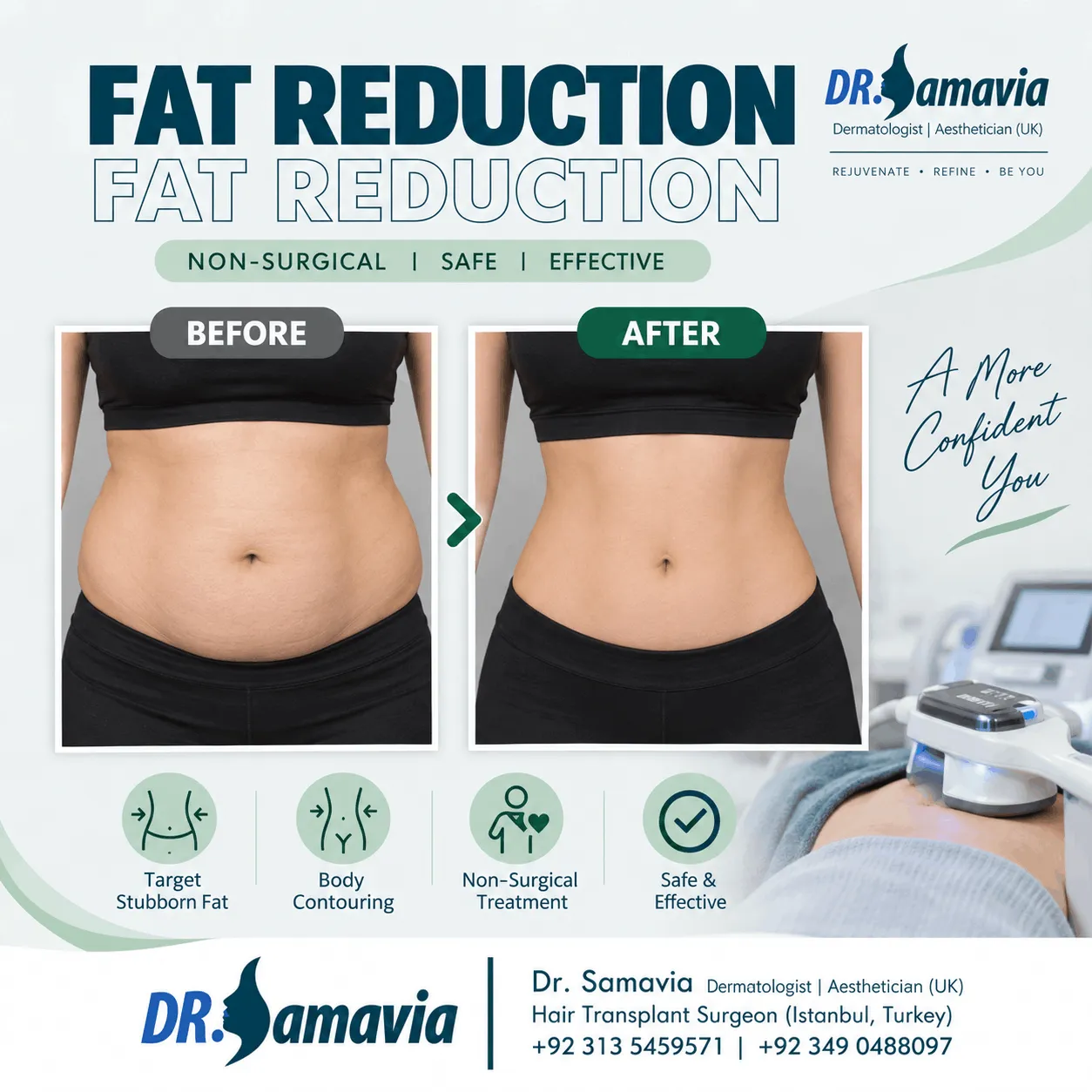
What is Fat Reduction?
Fat Reduction is a broad term covering procedures intended to decrease the thickness or visibility of selected fat deposits.
Non-surgical Fat Reduction may use technologies including:
- Cryolipolysis or fat freezing
- Radiofrequency fat reduction
- Ultrasound-based fat reduction
- Selected laser-based fat reduction
- Other appropriately authorised body-contouring technologies
These procedures are performed from outside the skin and do not physically suction fat from the body.
This distinguishes them from liposuction, which is a surgical procedure that removes fat through a cannula inserted through small incisions.
The FDA describes non-invasive body contouring as procedures that can reduce small areas of fat and change the circumference or silhouette of selected body regions but do not remove tissue surgically.
What Is Fat Reduction Used For?
Non-surgical Fat Reduction may be considered for relatively small, resistant fat deposits in areas such as:
- Abdomen
- Flanks or love handles
- Inner thighs
- Outer thighs
- Back
- Upper arms
- Under the chin
- Selected areas around the knees
The American Academy of Dermatology notes that non-invasive fat reduction can be used across areas including the abdomen, flanks, thighs, chin, neck, back, upper arms and knees.
Treatment is generally most appropriate when a patient:
- Has a relatively stable weight
- Has localised fat resistant to lifestyle measures
- Does not require large-volume fat removal
- Prefers a non-surgical approach
- Has realistic expectations regarding modest contour improvement
What concerns can it address?
Abdominal Fat
Selected areas of pinchable subcutaneous abdominal fat may be suitable for non-invasive reduction.
Fat Reduction does not treat visceral fat, which lies deeper around the internal organs.
Visceral fat is primarily addressed through overall health and weight-management strategies rather than cosmetic devices.
Love Handles
Localised deposits around the waist or flanks can often be targeted separately from the abdomen.
Thigh Fat
Selected inner or outer thigh deposits may be suitable depending on:
- Fat thickness
- Skin quality
- Body proportions
- Device applicator
Upper-Arm Fat
Small fat deposits can sometimes be treated non-surgically.
If loose skin is the main problem, however, fat reduction alone may make laxity more noticeable.
Back Fat
Selected bulges around the back or bra-line area may be considered for treatment.
Double Chin
Submental fat beneath the chin can be treated with selected non-surgical technologies.
The appearance of a double chin can also be influenced by:
- Chin projection
- Skin laxity
- Neck anatomy
so reducing fat alone may not always provide the desired jawline.
Types of Non-Surgical Fat Reduction
Cryolipolysis — Fat Freezing
Cryolipolysis uses controlled cooling to damage selected fat cells.
A treatment applicator generally draws pinchable fat into a cooling chamber.
Because fat cells are particularly sensitive to controlled cold exposure, they can be damaged while treatment settings aim to preserve surrounding structures.
The body's immune system gradually clears the damaged fat cells.
The FDA states that this process generally occurs over approximately 2 to 3 months.
Cryolipolysis is primarily intended for localised fat bulges, not overall weight reduction.
Radiofrequency Fat Reduction
Radiofrequency systems generate controlled heat within selected tissues.
Depending on the specific device, RF treatment may be designed to:
- Damage selected fat cells
- Reduce circumference
- Improve body contour
- Produce selected skin-firming effects
Several treatment sessions may be required.
Ultrasound Fat Reduction
Therapeutic ultrasound uses focused sound-wave energy to affect selected fat tissue.
The treated fat is subsequently processed by the body.
Some ultrasound technologies require only a few sessions, although treatment schedules depend on the specific device.
Laser-Based Fat Reduction
Selected external laser systems use controlled heat to damage subcutaneous fat cells without traditional surgical removal.
These devices are different from laser-assisted liposuction, which is a minimally invasive surgical procedure involving cannula insertion.
The exact technology should therefore be identified rather than referring to every treatment simply as “laser fat removal.”
Potential benefits
Potential benefits of non-surgical Fat Reduction include:
- No traditional surgical incision
- Usually no general anaesthesia
- Minimal downtime with many technologies
- Can target selected stubborn fat deposits
- Gradual body-contour improvement
- Can treat several different body areas
- Most patients can return to normal activities relatively quickly
- Successfully destroyed fat cells do not simply regenerate
- Can be an option for patients not seeking surgical liposuction
The AAD reports that most patients can return to normal activities immediately after non-invasive fat removal and that results appear gradually.
Limitations and realistic expectations
Non-surgical Fat Reduction generally produces more modest changes than liposuction.
It cannot reliably provide:
- Major weight loss
- Treatment of obesity
- Large-volume fat removal
- Complete elimination of body fat
- Major tightening of substantial loose skin
- Surgical-level contouring
- Guaranteed centimetres of reduction
- Identical results in every patient
The AAD describes results as typically more subtle than liposuction, while ASPS specifically states that non-surgical fat-reduction methods are not replacements for liposuction.
Patients should therefore be cautious about claims such as:
- “Lose 10 kg without exercise”
- “One session melts all belly fat”
- “Same result as liposuction”
- “Permanent weight loss”
- “100% fat removal”
- “No risks or side effects”
These are not realistic descriptions of non-invasive Fat Reduction.
Fat Reduction vs Weight Loss
Fat Reduction and weight loss are fundamentally different.
Weight Loss
When body weight decreases, existing fat cells generally become smaller throughout the body.
Appropriate weight loss can also produce important health benefits in people who are overweight or have obesity.
Localised Fat Reduction
Cosmetic fat-reduction treatments target only selected areas.
They are designed to:
- Reduce a localised bulge
- Improve contour
- Reduce circumference modestly
without significantly changing total body weight.
The FDA clearly states that non-invasive body contouring does not treat obesity, does not cause meaningful weight loss and does not produce the health benefits associated with losing excess weight.
Patients primarily seeking significant weight reduction should therefore consider appropriate medical weight-management strategies rather than a cosmetic fat-reduction package.
Who may be suitable?
A suitable candidate for non-surgical Fat Reduction is generally someone who:
- Is an adult
- Has a relatively stable body weight
- Has a small localised fat deposit
- Has realistic expectations
- Does not require major skin removal
- Prefers a non-surgical approach
The AAD describes an ideal candidate as someone whose weight is relatively normal for their height but who has a small resistant fat bulge despite diet and exercise.
A consultation should assess:
- Body weight
- Fat distribution
- Skin laxity
- Treatment area
- Previous surgery
- Hernias
- Medical conditions
- Implanted devices
- Pregnancy status
- Treatment expectations
Who may not be suitable?
Suitability depends on the specific technology.
Treatment may need to be avoided or modified in patients with:
- Pregnancy
- Breastfeeding
- Active infection
- Open wounds
- Significant uncontrolled medical illness
- Significant loose skin requiring surgical correction
- Hernia in or close to the treatment area
- Certain implanted medical devices
- Certain circulation disorders
ASPS advises against the commonly used non-surgical fat-reduction procedures during pregnancy or breastfeeding.
Fat-Freezing contraindications
Cryolipolysis may be inappropriate in patients with cold-related disorders including:
- Cryoglobulinemia
- Cold urticaria
- Paroxysmal cold haemoglobinuria
- Cold agglutinin disease
- Certain significant cold-related circulation problems
The FDA also advises against treatment in or near existing hernias or structurally weak areas of the abdominal wall.
Radiofrequency considerations
Patients should disclose:
- Pacemaker
- Implantable cardiac devices
- Metal implants
- Other implanted medical devices
because some energy-based systems may not be appropriate.
Device-specific contraindications must always be followed.
How to prepare
How to prepare
Before Fat Reduction treatment, tell your clinician about:
- Medical conditions
- Pregnancy or breastfeeding
- Previous abdominal or body surgery
- Hernias
- Cold-sensitivity disorders
- Circulation problems
- Pacemaker
- Metal implants
- Other implanted devices
- Medication
- Supplements
- Skin conditions
- Previous body-contouring treatment
The FDA specifically recommends informing the treating provider about medicines, supplements, implanted devices, scars, surgery, mesh, tattoos and other relevant features within the proposed treatment area.
Your clinician should also discuss:
- Exact device
- Treatment technology
- Treatment area
- Number of sessions
- Realistic degree of reduction
- Risks
- Expected timeline
Baseline photographs or circumference measurements may be useful for comparison.
How the procedure works
The procedure depends on the technology selected.
1. Body assessment
The clinician determines whether the main concern is:
- Localised fat
- Loose skin
- Cellulite
- General excess body weight
- A combination of these
2. Treatment-area marking
The fat deposit may be marked while the patient is standing.
3. Measurements and photography
Standardised photographs and circumference measurements may be recorded.
4. Treatment
Cryolipolysis
An applicator is placed over a suitable fat bulge.
Vacuum may draw tissue into the applicator before controlled cooling is delivered.
The FDA notes that cryolipolysis treatment can continue for up to approximately one hour depending on the device.
Radiofrequency
An applicator delivers controlled heat.
Patients may feel significant warmth but treatment should remain within device-specific safety limits.
Ultrasound
An ultrasound applicator is passed over the treatment region, often using coupling gel.
Laser-Based Treatment
Controlled external laser energy heats selected fat tissue according to the device protocol.
5. Final assessment
The skin and treatment area are checked.
6. Follow-up
Because results develop slowly, the treatment is reassessed after sufficient time rather than judging the result immediately.
Results and treatment timeline
Fat Reduction results develop gradually.
Immediately after treatment
There may be little visible change.
Temporary effects may include:
- Redness
- Swelling
- Tenderness
- Bruising
- Numbness
- Tingling
Around 3 weeks
Some patients may begin seeing early contour changes.
The AAD notes that changes from non-invasive fat reduction can sometimes become visible from about 3 weeks after treatment.
Around 2 to 3 months
Cryolipolysis results continue developing as damaged fat cells are gradually cleared.
The FDA gives approximately 2 to 3 months as the usual clearance period following fat freezing.
Around 3 to 6 months
The AAD reports that many patients see the fuller effect of device-based non-invasive fat removal within approximately 3 to 6 months after the final treatment.
Typical session numbers
The exact course varies by device.
AAD guidance gives broad examples of approximately:
- Cryolipolysis: commonly around 2 sessions
- Ultrasound: around 1 to 3 sessions depending on device
- Radiofrequency: around 4 to 10 sessions in some protocols
These should not be treated as guaranteed schedules for every device or patient.
Are Fat Reduction results permanent?
When a treatment successfully destroys individual fat cells, those particular cells are removed over time and do not simply regenerate.
However, other fat cells remain.
If the patient later gains significant weight, remaining fat cells can enlarge.
This means the treated region can become larger again even though the previously destroyed cells have not returned.
The AAD explains that destroyed fat cells are permanently gone, but remaining cells can expand when weight is gained.
Maintaining a relatively stable weight is therefore important for preserving result.
Risks and side effects
Risks vary considerably according to technology.
Common temporary effects may include:
- Redness
- Swelling
- Bruising
- Tenderness
- Pain
- Tingling
- Temporary numbness
The FDA cautions that although many complications resolve, some adverse effects from non-invasive body contouring can become persistent or require medical or surgical treatment.
Cryolipolysis risks
Possible complications include:
- Redness
- Swelling
- Bruising
- Pain
- Skin discolouration
- Persistent numbness
- Nodules
- Nerve symptoms
- Freeze burns
Paradoxical Adipose Hyperplasia
A rare but particularly important complication of cryolipolysis is Paradoxical Adipose Hyperplasia (PAH).
Instead of becoming smaller, fatty tissue within the treatment area enlarges.
The area may develop a:
- Firm
- Raised
- Visible
- Sometimes applicator-shaped
fat bulge.
The FDA states that reported PAH cases have generally appeared about 2 to 5 months after cryolipolysis.
PAH does not resolve spontaneously and may require surgery.
Radiofrequency risks
Potential complications may include:
- Pain
- Burns
- Blisters
- Persistent redness
- Skin injury
- Pigmentation changes
- Nodules
depending on the technology.
Ultrasound risks
Potential effects can include:
- Pain
- Redness
- Swelling
- Burns
- Blisters
- Nerve injury
Correct device placement and settings are important.
Recovery and aftercare
Many non-surgical Fat Reduction treatments require little conventional downtime.
Patients can often return to normal daily activities immediately.
Depending on the device, temporary:
- Swelling
- Bruising
- Tenderness
- Numbness
- Tingling
- Sensitivity
may persist.
The AAD notes that most patients return to normal activities immediately even though temporary swelling, bruising or discomfort may occur.
Aftercare may include:
- Follow device-specific instructions.
- Keep the treatment area clean.
- Avoid unnecessary pressure if the area is tender.
- Resume exercise according to clinician instructions.
- Maintain normal hydration.
- Avoid excessive heat if the skin is irritated.
- Maintain a stable body weight.
- Attend planned follow-up assessments.
Contact the clinic if you develop:
- Severe or worsening pain
- Significant blistering
- Burns
- Persistent numbness
- Skin breakdown
- Severe swelling
- Signs of infection
- An enlarging firm bulge after fat freezing
- Another unexpected reaction
Alternatives and comparisons
The most appropriate option depends on the amount of fat and desired result.
Fat Reduction vs Liposuction
Non-Surgical Fat Reduction:
- No surgical incision
- Usually no general anaesthesia
- Minimal downtime
- Gradual results
- Best for small localised deposits
- Often requires multiple treatments
Liposuction:
- Surgical procedure
- Uses a cannula to physically remove fat
- Can remove larger amounts
- More dramatic contour change
- Greater recovery
- Different surgical risks
ASPS states that non-surgical treatments provide alternatives for selected patients but are not replacements for liposuction.
Fat Reduction vs Body Contouring
Fat Reduction specifically focuses on decreasing localised fat.
Body Contouring is broader and can include treatments aimed at:
- Fat reduction
- Skin tightening
- Cellulite
- Muscle definition
- Overall body shape
A patient can therefore undergo body contouring without necessarily receiving a fat-reduction procedure.
Fat Reduction vs Weight-Loss Treatment
Medical weight-management programmes aim to reduce overall excess body weight and improve health where appropriate.
Fat Reduction treats specific cosmetic areas.
Someone seeking significant weight loss should not substitute a cosmetic device for an appropriate medical weight-management programme.
Fat Reduction vs Skin Tightening
Skin tightening targets lax or loose skin.
Fat Reduction targets fat.
If the patient has both excess fat and poor skin elasticity, reducing fat alone may not create a tighter appearance.
Assessment should therefore determine whether:
- Fat
- Skin
- Both
are contributing to the contour concern.
What affects the cost?
The cost of Fat Reduction depends on:
- Technology used
- Device
- Treatment area
- Size of the area
- Number of treatment cycles
- Number of applicators
- Amount of localised fat
- Number of sessions
- Whether multiple body areas are treated
- Combination with skin tightening
- Practitioner expertise
- Follow-up requirements
For example, treating a small submental area requires a different plan from treating:
- Full abdomen
- Abdomen plus flanks
- Both thighs
- Several body areas
Patients should therefore compare the exact treatment technology, not simply the phrase “fat reduction.”
The cheapest treatment is not necessarily the most appropriate.
Correct:
- Candidate selection
- Device selection
- Treatment parameters
- Medical screening
- Management of complications
are more important than simply performing the greatest possible number of treatment cycles
Patient experiences
Reviews describe individual experiences and do not predict another patient's result.
I had a wonderful experience consulting with Dr. Samaviya Ejaz. She is an incredibly impressive and professional dermatologist. Her clinic is beautiful and has a calming atmosphere.
Umar Shah
Read on GoogleI had my hair fall consultation with Dr Samavia. She thoroughly explained the treatment. After PRF sessions my hair fall stopped and density improved. Highly recommend.
Moneeb Mumtaz
Read on GoogleI have had a few treatments at this clinic and I am happy with the outcomes. Dr. Samavia and her team are kind, professional, and trustworthy.
Sheikh Yousuf Kareem
Read on GoogleVisit Dr Samavia at Facetime Clinic
Use the verified Google profile for clinic directions, business details and linked patient reviews.
Clinical references
- Non-Invasive Body Contouring TechnologiesU.S. Food and Drug Administration · accessed 30 August 2026
- Non-Invasive Fat Removal: What Can You Expect?American Academy of Dermatology · accessed 30 August 2026
- Cellulite and Fat RemovalAmerican Academy of Dermatology · accessed 30 August 2026
- Nonsurgical Fat Reductionmerican Society of Plastic Surgeons · accessed 30 August 2026
- Cryolipolysis — Nonsurgical Fat Reductionmerican Society of Plastic Surgeons · accessed 30 August 2026
- Cryolipolysis — Nonsurgical Fat Reductionmerican Society of Plastic Surgeons · accessed 30 August 2026
Fat Reduction FAQs
Does Fat Reduction help me lose weight?
No. Non-surgical Fat Reduction is intended to improve small localised fat deposits rather than produce meaningful overall weight loss. The FDA specifically states that non-invasive body contouring does not treat obesity or provide the health benefits associated with losing excess body weight. Patients primarily seeking significant weight loss should consider appropriate medical weight-management strategies instead.
How long does it take to see Fat Reduction results?
Results are gradual. Some patients may notice changes after about three weeks, while the AAD reports that the fuller effect of many device-based treatments develops approximately three to six months after the final session. With cryolipolysis, the FDA notes that damaged fat cells are generally cleared over about two to three months.
How many Fat Reduction sessions will I need?
The number depends on the technology and treatment area. AAD guidance gives broad examples of around two sessions for cryolipolysis, one to three treatments for certain ultrasound systems and several sessions for some radiofrequency treatments. The correct schedule should follow the specific device and patient's response rather than a universal package.
Are Fat Reduction results permanent?
Fat cells that are successfully destroyed do not simply grow back. However, remaining fat cells can enlarge if you gain weight, meaning the treated area can increase in size again. Maintaining a stable weight helps preserve the cosmetic result.
Is Fat Reduction better than liposuction?
Neither is universally better. Non-surgical Fat Reduction usually has less downtime and is suitable for relatively small resistant fat deposits, but its results are more modest. Liposuction surgically removes larger amounts of fat and generally provides a more substantial contour change. ASPS states that non-surgical fat reduction is not a replacement for liposuction.
Other Body & Skin Procedures guides
Book a consultation in Islamabad to review suitability, alternatives, expected recovery and individual risks.