
Skin Whitening Treatment in Islamabad
Skin Whitening Treatment is a broad term used for cosmetic and dermatological treatments intended to reduce excess pigmentation, improve uneven skin tone and create a brighter or more uniform complexion. A medically appropriate treatment plan should aim to bring areas of excess pigmentation closer to the patient's natural skin colour rather than promise permanent bleaching or an unnatural change in genetically determined skin tone.
Treatment may involve sun protection, clinician-directed topical products, chemical peels, microneedling, laser or light-based procedures, or a combination of approaches. The correct treatment depends on whether the concern is melasma, post-inflammatory hyperpigmentation, sun damage, acne-related dark marks or another pigment disorder.
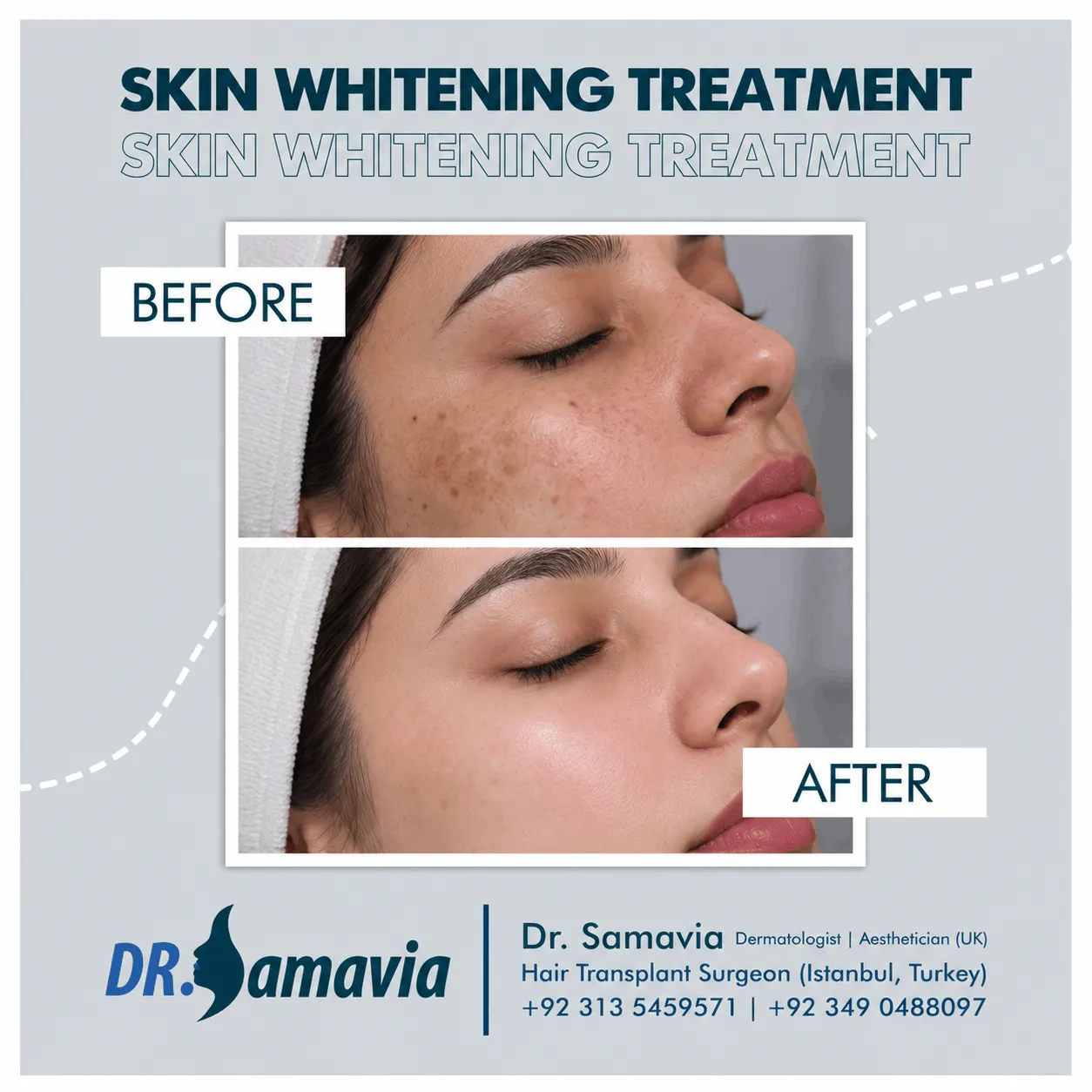
What is Skin Whitening Treatment?
Skin Whitening Treatment is commonly used as a marketing term for procedures or products intended to make the complexion appear lighter or brighter.
From a dermatological perspective, the safer and more realistic objective is usually treatment of excess pigmentation and uneven skin tone.
Skin colour is largely determined by melanin, a natural pigment produced by melanocytes. Melanin has an important biological role, including helping protect the skin from ultraviolet radiation.
Pigmentation can become uneven because of:
- Sun exposure
- Melasma
- Acne
- Skin inflammation
- Hormonal influences
- Age-related sun damage
- Certain medications
- Previous burns or irritation
- Aggressive cosmetic procedures
Treatment therefore focuses on controlling excessive or uneven melanin production rather than removing normal melanin from healthy skin.
The American Academy of Dermatology describes the goal of melasma treatment as reducing excess pigment and helping restore the skin toward its natural colour, rather than indiscriminately whitening normal skin.
What Is Skin Whitening Treatment Used For?
A skin-brightening or pigmentation-treatment plan may be considered for:
- Uneven skin tone
- Melasma
- Sun spots
- Age spots
- Post-acne dark marks
- Post-inflammatory hyperpigmentation
- Dull-looking complexion
- Selected superficial pigmentation
- General photoageing
- Areas that have become darker following inflammation
Treatment should be directed toward the underlying cause.
For example, a patient with melasma may require a very different plan from someone with a few isolated sun spots.
Similarly, persistent post-acne pigmentation usually requires both treatment of the pigment and good control of active acne so that new dark marks do not continually develop.
What concerns can it address?
Uneven skin tone
Excess pigment distributed irregularly across the face can make skin appear patchy or dull.
Sun protection, appropriate topical treatment and selected procedures may gradually improve the appearance.
Melasma
Melasma commonly causes symmetrical brown or grey-brown patches, particularly on:
- Cheeks
- Forehead
- Upper lip
- Chin
- Nose
Sunlight, visible light and hormonal factors can contribute.
Melasma is often chronic and recurrence is common even after successful treatment.
Post-acne pigmentation
Inflammation caused by acne can leave flat brown or grey marks after the active spot has healed.
This is commonly post-inflammatory hyperpigmentation (PIH) rather than a permanent acne scar.
Sun spots and age spots
Repeated ultraviolet exposure can produce localised darker areas such as solar lentigines.
Selected topical or procedural treatments may reduce their appearance after appropriate diagnosis.
Dull-looking skin
Superficial exfoliation, hydration, appropriate skincare and sun protection may improve the appearance of a dull complexion without attempting to change the person's natural skin colour.
Potential benefits
Depending on the diagnosis and treatment selected, possible benefits include:
- More even-looking skin tone
- Reduction in selected dark spots
- Improvement in post-acne pigmentation
- Improvement in melasma in responding patients
- Reduction of visible sun damage
- Brighter-looking complexion
- Improved skin clarity
- Ability to customise treatment according to skin type and pigmentation depth
- Improvement without attempting to permanently bleach normal skin
A successful treatment plan often combines corrective treatment with prevention, particularly daily sun protection.
Limitations and realistic expectations
Skin Whitening Treatment should not be promoted as permanent transformation of natural skin colour.
Natural skin tone is strongly influenced by genetics and normal melanin production.
Treatment cannot safely guarantee:
- Permanent fairer skin
- A specific number of shades of whitening
- Permanent reduction of all melanin
- Complete pigmentation removal after one session
- A permanent melasma cure
- Identical results in every skin type
- Zero risk of pigmentation returning
Melasma is especially prone to recurrence.
Post-inflammatory hyperpigmentation can also return if acne, irritation or other inflammation continues.
Aggressive treatment may actually cause additional inflammation and make pigmentation darker.
This is particularly important in medium and darker skin tones, where post-inflammatory hyperpigmentation can occur following inappropriate laser, peel or other treatment.
Which Skin Whitening Treatments May Be Used?
There is no single treatment suitable for everyone.
A clinician-directed plan may involve one or more of the following.
Sun Protection
Sun protection is one of the most important parts of pigmentation treatment.
Broad-spectrum sunscreen helps prevent ultraviolet exposure from stimulating additional pigment production.
For melasma, tinted sunscreen containing iron oxides may also help protect against visible light.
The American Academy of Dermatology recommends broad-spectrum SPF 30 or higher and highlights zinc oxide, titanium dioxide and iron oxide-containing sunscreens for melasma management.
Topical Pigmentation Treatment
Depending on diagnosis and local prescribing regulations, treatment may include ingredients such as:
- Azelaic acid
- Retinoids
- Vitamin C
- Kojic acid
- Hydroquinone when medically appropriate and prescribed
- Combination pigmentation preparations
Hydroquinone can be useful for selected pigmentation disorders when appropriately prescribed and monitored.
However, prolonged or inappropriate use can cause irritation and, rarely, exogenous ochronosis, which can produce persistent abnormal dark pigmentation.
In the United States, hydroquinone is no longer permitted in legally marketed over-the-counter skin-lightening products, although prescription formulations may still be used under medical supervision.
Chemical Peels
Selected chemical peels can remove superficial pigmented skin cells and may improve:
- Post-inflammatory pigmentation
- Sun damage
- Uneven tone
- Selected melasma
The strength of the peel must be chosen according to skin type and pigmentation tendency.
Microneedling
Microneedling creates controlled microscopic injuries and may be incorporated into selected pigmentation or melasma treatment plans.
It should be performed cautiously because excessive inflammation can itself trigger pigmentation.
Laser and Light-Based Treatment
Laser or IPL treatment may be considered for selected pigmentation disorders.
Different devices target different pigment depths and skin structures.
Laser treatment is not automatically appropriate for every case of melasma or every skin tone.
Inappropriate energy settings can cause:
- Burns
- Darker pigmentation
- Lighter pigmentation
- Recurrence
- Scarring
Other Medical Treatments
Certain patients with resistant pigmentation or melasma may be considered for additional prescription treatments following medical assessment.
These should be selected according to individual risk rather than used as generic “whitening” medicines.
Unsafe Skin Whitening Products
Unregulated skin-whitening products can contain harmful ingredients.
Particular concern exists around mercury-containing creams and soaps.
The World Health Organization states that mercury-containing skin-lightening products are hazardous and can cause health problems including kidney, nervous-system and skin damage. International efforts under the Minamata Convention aim to eliminate mercury-containing skin-lightening cosmetics.
The U.S. FDA has also found illegally marketed skin-lightening products containing high levels of mercury or undeclared hydroquinone.
Repeated exposure to mercury can potentially cause serious and permanent harm, including kidney and neurological injury.
Patients should therefore avoid:
- Unlabelled whitening creams
- Products with unknown ingredients
- Mercury-containing products
- Homemade bleaching mixtures
- Unregulated steroid-containing creams
- Products promising dramatic permanent whitening
- Injections or infusions with unclear ingredients or regulatory status
A product being described as “herbal,” “natural” or “imported” does not automatically mean it is safe.
Who may be suitable?
Treatment may be considered for adults with:
- Uneven pigmentation
- Melasma
- Post-acne dark marks
- Post-inflammatory hyperpigmentation
- Sun spots
- Age-related pigmentation
- Dull-looking skin
- Realistic expectations regarding natural skin tone
Before recommending treatment, the clinician may assess:
- Skin type
- Natural skin colour
- Pigmentation pattern
- Depth of pigmentation
- Duration
- Sun exposure
- Hormonal factors
- Current skincare
- Previous whitening products
- Previous laser or peel treatment
- Tendency toward post-inflammatory pigmentation
- Medical conditions
- Current medication
The treatment goal should be agreed before starting therapy.
Who may not be suitable?
Specific treatments may need to be postponed or modified in patients with:
- Active skin infection
- Open wounds
- Severe active acne
- Significant dermatitis
- Sunburn
- Recent significant tanning
- Uncontrolled inflammatory skin disease
- Known allergy to a proposed product
- Certain photosensitive conditions
- Certain photosensitising medicines
- Previous severe pigmentation changes after cosmetic procedures
Pregnancy and breastfeeding can affect which topical and prescription treatments are appropriate.
Suspicious pigmented lesions
Any pigmented spot that is:
- New
- Changing
- Irregular
- Rapidly enlarging
- Bleeding unexpectedly
- Changing colour
- Significantly different from other spots
should be medically assessed before cosmetic treatment.
A suspicious mole should not simply be destroyed using whitening cream, chemical peel or laser.
How to prepare
Before treatment, tell your clinician about:
- Prescription medications
- Skincare products
- Retinoids
- Hydroquinone use
- Previous whitening products
- Steroid-containing creams
- Allergies
- Previous chemical peels
- Previous laser treatment
- Recent tanning
- Sunburn
- History of pigmentation after procedures
- Pregnancy or breastfeeding
- Medical conditions
Bring or photograph any skin-whitening products you currently use if their ingredients are unclear.
Before procedural treatment
Your clinician may advise temporarily stopping certain:
- Retinoids
- Exfoliating acids
- Physical scrubs
- Irritating active ingredients
before treatment.
Sun exposure should also be minimised.
Do not stop prescribed medication without advice from the clinician responsible for your care.
How the procedure works
Because Skin Whitening Treatment is personalised, the exact process varies.
1. Skin assessment
The clinician determines whether the concern is:
- Melasma
- Post-inflammatory pigmentation
- Sun damage
- Post-acne pigmentation
- Another condition
2. Skin-type assessment
Natural skin tone and the risk of post-inflammatory pigmentation are assessed.
3. Treatment planning
The clinician selects the safest appropriate treatment.
This may include:
- Topical medication
- Medical skincare
- Chemical peel
- Microneedling
- Laser or light treatment
- Combination therapy
4. Procedure
For procedural treatment, the skin is cleaned and the selected treatment is performed using an appropriate protocol.
5. Skin protection
Moisturiser and sunscreen may be applied afterward depending on the procedure.
6. Maintenance plan
Long-term sun protection and skincare instructions are provided to help reduce recurrence.
Results and treatment timeline
Improvement in pigmentation generally develops gradually.
First several weeks
Some superficial pigmentation or general brightness may begin improving.
Several months
Conditions such as melasma usually require consistent treatment over a longer period.
The American Academy of Dermatology notes that melasma treatment may take approximately 3 to 12 months to produce results.
After procedural treatment
Some pigmented spots can initially become temporarily darker before fading.
Peeling, redness or mild crusting may occur depending on the procedure.
Long-term
Treatment does not prevent new pigmentation from developing.
Ongoing:
- Sunscreen
- Appropriate skincare
- Control of acne or inflammation
- Maintenance treatment when appropriate
may be needed.
Risks and side effects
Risks depend on the treatment used.
Topical treatment
Possible effects include:
- Dryness
- Redness
- Irritation
- Burning
- Peeling
- Allergic reaction
- Worsening pigmentation
Inappropriate long-term hydroquinone use can rarely cause ochronosis.
Chemical peels
Possible complications include:
- Redness
- Peeling
- Burning
- Hyperpigmentation
- Hypopigmentation
- Infection
- Scarring
Laser and light treatment
Possible complications include:
- Pain
- Redness
- Swelling
- Burns
- Blisters
- Crusting
- Hyperpigmentation
- Hypopigmentation
- Infection
- Scarring
- Worsening melasma
Harmful whitening products
Mercury-containing skin-lightening products can cause much more than local skin irritation.
WHO identifies potential harm including kidney and nervous-system damage, while the FDA warns that repeated exposure can produce serious and potentially permanent health problems.
Recovery and aftercare
Recovery depends on the treatment selected.
After mild topical or non-invasive treatment, downtime may be minimal.
After peels or laser treatment, temporary:
- Redness
- Dryness
- Peeling
- Crusting
- Darkening of treated pigmentation
may occur.
Patients may be advised to:
- Use gentle cleanser.
- Moisturise appropriately.
- Avoid picking or peeling skin.
- Avoid unnecessary direct sun exposure.
- Use broad-spectrum SPF 30+ sunscreen daily.
- Use tinted sunscreen for melasma when recommended.
- Avoid unapproved bleaching creams.
- Avoid aggressive scrubs.
- Restart active skincare only as instructed.
- Continue prescribed pigmentation treatment consistently.
Contact the clinic if you experience:
- Severe pain
- Significant blistering
- Increasing swelling
- Pus or discharge
- Fever
- Severe unexpected darkening
- Persistent whitening of treated skin
- Another significant reaction
Alternatives and comparisons
The best treatment depends on what the patient means by “whitening.”
For Uneven Pigmentation
Options may include:
- Sunscreen
- Azelaic acid
- Clinician-directed pigmentation creams
- Retinoids
- Chemical peels
- Microneedling
- Selected laser treatment
For Melasma
Management commonly includes:
- Strict sun protection
- Tinted sunscreen
- Hydroquinone when medically appropriate
- Triple-combination prescription treatment
- Azelaic acid
- Retinoid-based treatment
- Selected procedures
- Longer-term maintenance
For Post-Acne Pigmentation
Control of active acne is important.
Options may then include:
- Sunscreen
- Azelaic acid
- Retinoids
- Other pigmentation products
- Selected chemical peels
- Selected procedural treatments
Skin Whitening vs Pigmentation Removal
Skin Whitening Treatment is often marketed as making the entire complexion lighter.
Pigmentation Removal more accurately focuses on areas containing excess or uneven melanin.
From a medical perspective, restoring uneven pigmentation toward the patient's natural skin tone is a more realistic and safer goal than attempting to permanently lighten normal skin.
Skin Whitening vs Vitamin Infusion
Topical and procedural pigmentation treatments act primarily on the skin.
IV “whitening” infusions use intravenously administered ingredients and have a different evidence and safety profile.
They should not be considered interchangeable.
Skin Whitening vs Chemical Peel
A chemical peel is one possible tool within a pigmentation-treatment programme.
It provides controlled exfoliation but does not permanently change genetically determined skin colour.
Skin Whitening vs Laser Treatment
Laser treatment may selectively target certain pigmentation.
It can be effective for appropriate lesions, but it is not automatically the safest choice for every patient, particularly in melasma or patients prone to post-inflammatory pigmentation.
What affects the cost?
The cost of Skin Whitening Treatment depends on:
- Underlying pigmentation diagnosis
- Size of the treatment area
- Type of procedure
- Medical skincare required
- Chemical peel used
- Laser or light technology
- Number of sessions
- Severity of pigmentation
- Combination treatments
- Follow-up requirements
A patient seeking treatment for a few sun spots may require a very different plan from a patient with widespread melasma.
For this reason, a fixed “whitening package” should not automatically be recommended to every patient.
Treatment should prioritise:
- Correct diagnosis
- Safe ingredients
- Appropriate technology
- Natural-looking improvement
- Long-term pigmentation control
rather than promising the maximum number of shades of lightening.
Patient experiences
Reviews describe individual experiences and do not predict another patient's result.
I had a wonderful experience consulting with Dr. Samaviya Ejaz. She is an incredibly impressive and professional dermatologist. Her clinic is beautiful and has a calming atmosphere.
Umar Shah
Read on GoogleI had my hair fall consultation with Dr Samavia. She thoroughly explained the treatment. After PRF sessions my hair fall stopped and density improved. Highly recommend.
Moneeb Mumtaz
Read on GoogleI have had a few treatments at this clinic and I am happy with the outcomes. Dr. Samavia and her team are kind, professional, and trustworthy.
Sheikh Yousuf Kareem
Read on GoogleVisit Dr Samavia at Facetime Clinic
Use the verified Google profile for clinic directions, business details and linked patient reviews.
Clinical references
- Melasma: Diagnosis and TreatmentAmerican Academy of Dermatology · accessed 29 August 2026
- FDA Warns Consumers of Skin Products Containing Mercury and/or HydroquinoneU.S. Food and Drug Administration · accessed 29 August 2026
- Skin Product Safety: Skin-Lightening ProductsU.S. Food and Drug Administration · accessed 29 August 2026
- Elimination of Mercury-Containing Skin Lightening ProductsWorld Health Organization · accessed 29 August 2026
- Mercury in Skin Lightening ProductsWorld Health Organization · accessed 29 August 2026
- Understanding the Use of Skin Lightening ProductsWorld Health Organization · accessed 29 August 2026
Skin Whitening Treatment FAQs
Can Skin Whitening Treatment permanently make my skin fairer?
No treatment can safely guarantee permanent transformation of a person's natural genetically determined skin colour. Medical treatment is better directed toward excess pigmentation, sun damage or uneven skin tone, with the goal of bringing darker areas closer to the person's natural complexion.
What is the safest Skin Whitening Treatment?
There is no single safest treatment for everyone. Sun protection is fundamental, while clinician-directed topical treatments, chemical peels or selected laser procedures may be appropriate depending on the diagnosis and skin type. Unregulated whitening creams—particularly products containing mercury or undisclosed ingredients—should be avoided.
How long does Skin Whitening Treatment take to show results?
The timeline depends on the condition. Mild superficial pigmentation may begin improving over several weeks, while melasma often requires several months of consistent treatment. The American Academy of Dermatology notes that melasma treatment may take approximately 3 to 12 months.
Can Skin Whitening Treatment remove melasma permanently?
Melasma can improve substantially, but it is a chronic and recurrence-prone pigment condition. Sunlight, visible light and hormonal factors can trigger it again. Long-term sunscreen and maintenance treatment are therefore often more realistic than expecting a permanent one-time cure.
Are whitening creams safe?
Not all whitening creams are safe. Some illegal or unregulated products have been found to contain mercury, undeclared hydroquinone or other potentially harmful ingredients. WHO and FDA warn that mercury-containing skin-lightening products can cause serious health problems. Clinician-directed treatment with clearly labelled products is safer than using unknown bleaching creams.
Other Body & Skin Procedures guides
Book a consultation in Islamabad to review suitability, alternatives, expected recovery and individual risks.