
Stretch Marks Treatment in Islamabad
Stretch Marks Treatment refers to topical and procedural treatments designed to reduce the visibility, colour contrast and textural irregularity of stretch marks, medically known as striae distensae. Stretch marks are a form of dermal scarring that can develop when the skin stretches or changes rapidly, disrupting collagen and elastin within the supporting layers of the skin.
Treatment can make stretch marks less noticeable, but complete removal cannot be guaranteed. Newer red, pink or purple stretch marks often respond differently from older white or silvery stretch marks, and the best treatment depends on their age, colour, location, skin type and depth.
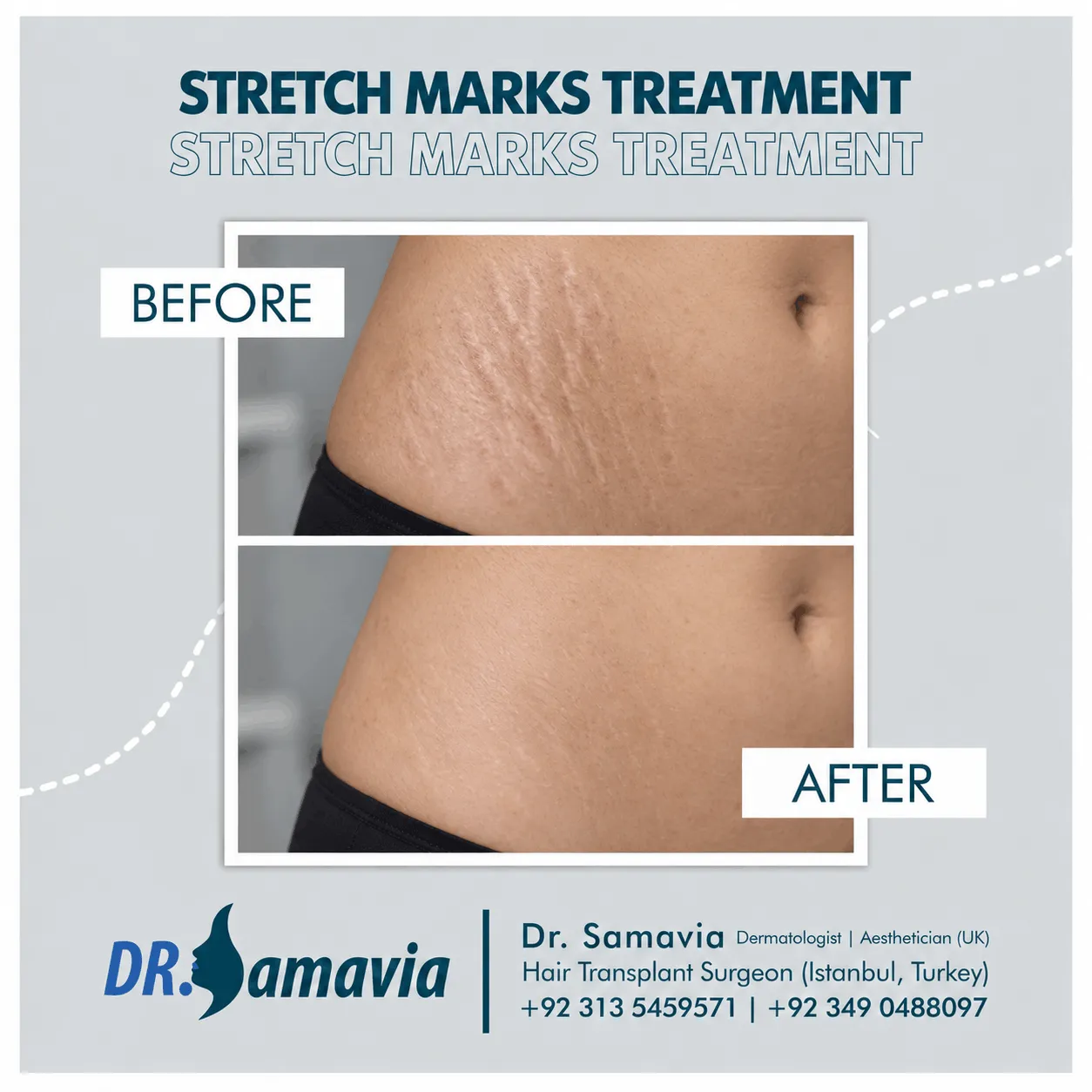
What is Stretch Marks Treatment?
Stretch marks, or striae distensae, are linear areas of altered skin that develop when the skin expands or contracts relatively quickly.
Rapid change can disrupt the normal structure of:
- Collagen
- Elastin
- Supporting dermal tissue
As the skin heals, visible streaks can develop.
The American Academy of Dermatology describes a stretch mark as a type of scar caused when rapid stretching or shrinking disrupts collagen and elastin.
Stretch marks commonly occur during:
- Pregnancy
- Puberty
- Rapid growth
- Rapid weight gain
- Rapid weight loss
- Rapid increase in muscle size
- Certain hormonal conditions
- Long-term corticosteroid exposure
Genetics and hormonal influences may also affect susceptibility.
Common treatment areas include:
- Abdomen
- Hips
- Thighs
- Buttocks
- Breasts
- Upper arms
- Lower back
- Shoulders
Stretch marks are medically harmless in most cases, although some patients seek treatment because of their appearance.
Types of Stretch Marks
An important part of treatment planning is determining whether stretch marks are relatively new or mature.
Striae Rubrae — Newer Stretch Marks
New stretch marks may appear:
- Red
- Pink
- Purple
- Reddish-brown
- Dark brown depending on skin tone
They may initially be slightly raised or itchy.
These are commonly called striae rubrae.
Early stretch marks generally contain more vascular and inflammatory activity and may respond better to certain treatments than mature stretch marks.
Striae Albae — Older Stretch Marks
As stretch marks mature, they usually become:
- White
- Silvery
- Pale
- Less vascular
- Slightly depressed
These are called striae albae.
Older stretch marks are generally more difficult to improve because they behave more like established scars.
Treatment can still improve their texture or visibility, but complete disappearance is unrealistic.
What Is Stretch Marks Treatment Used For?
Stretch Marks Treatment may be considered for stretch marks associated with:
- Pregnancy
- Weight changes
- Puberty
- Rapid growth
- Bodybuilding
- Muscle gain
- Previous obesity
- Hormonal changes
- Other periods of rapid tissue expansion
Treatment aims to improve one or more characteristics, including:
- Colour
- Width
- Texture
- Depression
- Contrast with surrounding skin
- Overall visibility
The objective is usually to make stretch marks less noticeable, not to restore the skin exactly to its pre-stretch-mark appearance.
Mayo Clinic and the AAD both note that treatments may improve stretch marks, but they may never disappear completely.
What concerns can it address?
Red or Purple Stretch Marks
Newer stretch marks may respond to treatments aimed at:
- Colour
- Vascularity
- Early collagen changes
Topical treatments may also have greater potential benefit during this earlier stage.
White Stretch Marks
Older white stretch marks generally require treatments focused more on:
- Collagen remodelling
- Texture
- Dermal restructuring
Possible approaches can include microneedling, radiofrequency microneedling or fractional laser treatment.
Depressed Skin Texture
Mature stretch marks can sit slightly below the surrounding skin.
Collagen-remodelling procedures may gradually reduce this textural difference.
Widespread Stretch Marks
Treatment can be performed over larger areas, although treating extensive:
- Abdomen
- Thighs
- Hips
- Buttocks
may require multiple sessions and greater overall treatment time.
Potential benefits
Depending on treatment choice, potential benefits may include:
- Reduced stretch-mark visibility
- Improvement in colour contrast
- Smoother appearance
- Improvement in depressed texture
- Stimulation of dermal collagen remodelling
- Improvement in both newer and selected older stretch marks
- Ability to customise treatment according to skin type
- Combination treatments may provide additional improvement in selected cases
Procedural treatments used by dermatologists can include:
- Laser therapy
- Microneedling
- Radiofrequency
- Chemical peels
- Microdermabrasion
- Other appropriately selected procedures
The AAD emphasizes that no single treatment works for everyone and that dermatologists sometimes combine procedures to improve results.
Limitations and realistic expectations
The most important limitation is that stretch marks are scars.
Treatment can make them less visible, but there is currently no reliable treatment that guarantees complete removal.
Patients should therefore be cautious about claims such as:
- “100% Stretch Marks Removal”
- “Stretch marks permanently erased”
- “One-session complete removal”
- “Skin becomes exactly like before pregnancy”
- “Permanent scar-free skin”
- “Guaranteed results for every skin type”
Treatment response depends on:
- Age of the stretch marks
- Colour
- Depth
- Width
- Body area
- Natural skin tone
- Skin healing response
- Treatment selected
- Number of sessions
- Previous treatment
- Ongoing weight or hormonal changes
Mayo Clinic notes that no available treatment has been consistently shown to outperform all others, reinforcing the need for individual treatment selection.
What Causes Stretch Marks?
Stretch marks develop when the skin undergoes rapid mechanical and biological change.
Common situations include:
Pregnancy
Stretch marks frequently develop over the abdomen, breasts, hips or thighs during pregnancy.
Hormonal and mechanical factors both contribute.
Puberty
Rapid height and body-shape changes during adolescence can produce stretch marks.
Weight Gain
Rapid expansion of body tissue can stretch the skin.
Rapid Weight Loss
Major changes in body volume can also be associated with stretch-mark development or make existing marks more noticeable.
Bodybuilding
Rapid muscle growth can create stretch marks, particularly around:
- Shoulders
- Upper arms
- Chest
- Thighs
Corticosteroid Exposure
Long-term use of corticosteroid medication can reduce collagen support and contribute to stretch marks.
Medical Conditions
Rarely, widespread or unusual stretch marks can occur with conditions involving excessive cortisol, such as Cushing syndrome, or certain connective-tissue disorders.
Mayo Clinic recommends medical assessment when stretch marks are extensive or when an underlying medical cause is suspected.
Which Stretch Marks Treatments May Be Used?
Treatment should be selected according to whether the marks are early or mature, as well as the patient's skin type.
Microneedling
Microneedling uses fine sterile needles to create controlled microscopic channels within the skin.
This stimulates a wound-healing response involving:
- Collagen production
- Tissue remodelling
- Gradual textural improvement
It can be used for both newer and mature stretch marks.
A 2024 systematic review and meta-analysis found evidence supporting microneedling for striae distensae, with effectiveness broadly comparable with laser treatment in some comparisons.
Radiofrequency Microneedling
RF microneedling combines:
- Controlled needle penetration
- Radiofrequency energy
to deliver heat into selected dermal depths.
This can stimulate collagen remodelling while treating textural irregularity.
A 2024 systematic review comparing fractional microneedle radiofrequency with fractional CO2 laser found broadly comparable improvement, while post-inflammatory hyperpigmentation occurred less frequently with fractional microneedle RF in the included studies.
Fractional CO2 Laser
Fractional CO2 laser creates controlled microscopic thermal treatment zones within the skin.
This can stimulate:
- Collagen remodelling
- New tissue formation
- Improvement in texture
Fractional CO2 treatment may be useful for established stretch marks but generally involves:
- More redness
- More downtime
- Greater risk of post-inflammatory pigmentation
particularly in darker skin tones.
A 2025 meta-analysis comparing fractional CO2 laser with microneedling found both approaches improved stretch marks, but post-inflammatory hyperpigmentation was significantly more common with fractional CO2 laser.
Other Fractional Lasers
Non-ablative fractional lasers may also be considered.
They usually produce less surface injury than ablative CO2 treatment but may still require multiple sessions.
Vascular Laser Treatment
Certain vascular lasers may be considered for relatively new red stretch marks where vascular colour is a significant component.
They do not treat established white stretch marks in exactly the same way.
Topical Tretinoin
Prescription tretinoin may improve early stretch marks in selected patients.
It appears to have substantially less effect on mature stretch marks.
Mayo Clinic notes that topical tretinoin can improve stretch marks that are only a few months old by supporting collagen remodelling.
Tretinoin can cause:
- Irritation
- Redness
- Dryness
- Peeling
Retinoids require particular caution during pregnancy.
Hyaluronic Acid
The AAD reports that topical hyaluronic acid has shown some evidence of making early stretch marks less noticeable.
It should not be expected to remove mature established stretch marks.
Chemical Peels
Selected chemical peels may be used to improve superficial texture or pigmentation.
Peel depth must be adjusted carefully according to skin type.
Combination Treatment
In selected patients, a clinician may combine approaches such as:
- Microneedling + topical treatment
- RF microneedling + other procedures
- Fractional laser + another modality
- Treatment for colour + treatment for texture
Combination therapy may be particularly useful when stretch marks have several different characteristics.
Do Stretch Mark Creams Work?
Many creams, oils and lotions are promoted for stretch marks.
Evidence is mixed and generally limited.
The AAD reports that commonly promoted products such as:
- Cocoa butter
- Olive oil
- Almond oil
- Vitamin E
have not been shown to reliably fade existing stretch marks in studies.
Mayo Clinic similarly states that strong evidence does not support popular oils and creams for eliminating stretch marks.
Moisturising can still improve:
- Dryness
- Comfort
- Skin softness
but moisturizing is not the same as removing an established dermal scar.
Topical treatments that have some evidence for early stretch marks include selected:
- Retinoids
- Hyaluronic acid-containing products
but expectations should remain conservative.
Who may be suitable?
Stretch Marks Treatment may be considered for adults with:
- Red stretch marks
- Purple stretch marks
- White stretch marks
- Pregnancy-related stretch marks after appropriate timing
- Weight-change stretch marks
- Growth-related stretch marks
- Bodybuilding-related stretch marks
- Realistic expectations
An assessment should consider:
- Skin type
- Stretch-mark colour
- Age of stretch marks
- Body area
- Width and depth
- Pregnancy or breastfeeding
- Medical history
- Medication
- Previous treatments
- Tendency toward pigmentation
- Tendency toward abnormal scarring
Patients with darker skin tones require particularly careful treatment selection to reduce the risk of post-inflammatory hyperpigmentation.
Who may not be suitable?
Specific procedures may need to be postponed or modified in patients with:
- Active infection
- Open wounds
- Active inflammatory skin disease
- Significant sunburn
- Recent tanning
- Poor wound healing
- Significant tendency toward keloid scarring
- Certain photosensitive conditions
- Certain medications
- Uncontrolled medical illness
Pregnancy
Elective procedural treatment is generally postponed during pregnancy.
Prescription retinoids such as tretinoin should also be discussed carefully with a healthcare professional because retinoid exposure is avoided during pregnancy.
Mayo Clinic specifically advises patients who are pregnant or nursing to discuss treatment options before using retinoid-containing products.
Unusual stretch marks
Medical assessment may be appropriate when stretch marks:
- Develop suddenly without obvious cause
- Are unusually wide
- Are widespread
- Appear together with other symptoms
- Develop during prolonged corticosteroid use
because an underlying hormonal or medical condition may occasionally contribute.
How to prepare
Before Stretch Marks Treatment, tell your clinician about:
- Pregnancy or breastfeeding
- Current medications
- Corticosteroid use
- Retinoids
- Previous isotretinoin
- Previous laser treatment
- Microneedling
- Previous pigmentation changes
- Keloid or abnormal scarring
- Allergies
- Medical conditions
- Recent tanning
- Sunburn
Before a procedural treatment, you may be advised to:
- Avoid tanning.
- Protect the area from excessive sun exposure.
- Temporarily stop irritating skincare.
- Avoid aggressive exfoliation.
- Follow procedure-specific skincare instructions.
Do not stop prescribed medication without advice from the clinician responsible for your care.
How the procedure works
The exact procedure depends on the treatment selected.
1. Stretch-mark assessment
The clinician evaluates:
- Colour
- Age
- Width
- Depth
- Location
- Skin type
2. Photography
Baseline photographs may be taken using consistent lighting.
This is useful because improvement develops gradually.
3. Treatment planning
A treatment is selected according to whether the marks are:
- Newer and vascular
- Mature and white
- Predominantly textural
- Mixed
4. Anaesthesia
For microneedling, RF microneedling or stronger laser treatment, topical anaesthetic may be applied.
5. Procedure
Depending on the treatment:
Microneedling creates controlled microscopic punctures.
RF microneedling delivers additional thermal energy through needles.
Fractional laser produces microscopic thermal treatment zones.
Vascular laser may selectively address redness in early stretch marks.
6. Cooling or soothing care
The treated skin may be cooled or treated with an appropriate soothing product.
7. Aftercare
Patients receive instructions regarding:
- Cleansing
- Moisturising
- Sun protection
- Active skincare
- Exercise
- Heat exposure
depending on the procedure.
Results and treatment timeline
Stretch Marks Treatment produces gradual improvement.
Immediately after treatment
Following microneedling or laser treatment, temporary:
- Redness
- Swelling
- Warmth
- Tenderness
may occur.
First several days
The treated skin may become:
- Dry
- Rough
- Mildly swollen
- Temporarily darker
depending on treatment intensity.
Several weeks
Initial healing occurs and gradual collagen remodelling begins.
Several months
The appearance of stretch marks may continue improving as dermal remodelling progresses.
Changes may include:
- Reduced width
- Improved texture
- Reduced colour contrast
- Less obvious depression
Multiple sessions
Most procedural treatments are performed as a course.
The exact number should not be guaranteed in advance because response varies considerably.
Risks and side effects
Risks depend on the treatment selected.
Microneedling
Possible effects include:
- Redness
- Swelling
- Pinpoint bleeding
- Tenderness
- Temporary dryness
- Infection
- Hyperpigmentation
- Scarring in uncommon cases
Radiofrequency Microneedling
Possible effects include:
- Pain
- Redness
- Swelling
- Crusting
- Burns
- Pigmentation changes
- Infection
- Scarring
Fractional Laser
Possible effects include:
- Redness
- Swelling
- Burning
- Crusting
- Hyperpigmentation
- Hypopigmentation
- Infection
- Scarring
Post-inflammatory hyperpigmentation is particularly important when treating darker skin.
Recent comparative evidence suggests that fractional CO2 laser may carry a higher PIH risk than microneedling or fractional microneedle radiofrequency in stretch-mark treatment.
Topical Tretinoin
Possible effects include:
- Dryness
- Peeling
- Burning
- Redness
- Irritation
Recovery and aftercare
Aftercare depends on the procedure.
Patients may be advised to:
- Clean the area gently.
- Use an appropriate moisturiser.
- Avoid scratching.
- Avoid picking crusted skin.
- Avoid strong exfoliating acids temporarily.
- Avoid retinoids until instructed.
- Avoid excessive heat.
- Avoid swimming until the skin has adequately healed when treatment is invasive.
- Protect exposed treatment areas from ultraviolet radiation.
- Use broad-spectrum sunscreen when appropriate.
After laser or microneedling procedures, temporary redness and swelling are expected.
Contact the clinic if you develop:
- Severe increasing pain
- Significant blistering
- Spreading redness
- Pus or discharge
- Fever
- Persistent abnormal pigmentation
- Delayed wound healing
- Another significant unexpected reaction
Alternatives and comparisons
The most appropriate approach depends on the stretch marks.
Microneedling vs Fractional CO2 Laser
Both treatments aim to stimulate dermal remodelling.
Recent meta-analyses suggest both can provide improvement.
However, fractional CO2 laser is associated with greater post-inflammatory hyperpigmentation risk in comparative studies, which is especially important for patients with darker skin tones.
Microneedling vs RF Microneedling
Traditional microneedling creates controlled mechanical injury.
RF microneedling adds radiofrequency heat within the dermis.
Both can stimulate remodelling.
The most suitable option depends on:
- Skin type
- Stretch-mark depth
- Treatment area
- Downtime preference
- Practitioner experience
Stretch Marks Treatment vs Body Contouring
Stretch Marks Treatment targets dermal scars.
Body Contouring primarily targets:
- Localised fat
- Body shape
- Selected skin laxity
- Cellulite
Reducing abdominal fat does not automatically remove abdominal stretch marks.
Stretch Marks Treatment vs Skin Tightening
Skin-tightening treatments aim to improve general laxity.
Stretch marks represent areas of altered dermal tissue.
A skin-tightening procedure may improve overall skin appearance but does not necessarily correct stretch marks unless the technology has evidence for striae treatment.
Stretch Marks Treatment vs Surgical Skin Removal
After major weight loss or pregnancy, a patient may have both:
- Stretch marks
- Significant loose abdominal skin
A tummy tuck can remove some stretch-marked skin if that skin lies within the area surgically removed.
However, it does not directly treat stretch marks that remain outside the excised area.
What affects the cost?
The cost of Stretch Marks Treatment depends on:
- Treatment method
- Body area
- Size of the area
- Number of stretch marks
- Age of the stretch marks
- Red versus white stretch marks
- Microneedling versus RF microneedling
- Laser technology
- Number of sessions
- Combination treatments
- Practitioner expertise
- Follow-up requirements
Treating a few small marks on the upper arm requires a very different treatment plan from treating extensive:
- Abdominal
- Thigh
- Hip
- Buttock
stretch marks.
A fixed package should therefore not automatically be recommended before assessment.
The treatment plan should prioritise:
- Skin type
- Stretch-mark stage
- Evidence
- Risk of pigmentation
- Realistic degree of improvement
rather than simply selecting the strongest laser available.
Patient experiences
Reviews describe individual experiences and do not predict another patient's result.
I had a wonderful experience consulting with Dr. Samaviya Ejaz. She is an incredibly impressive and professional dermatologist. Her clinic is beautiful and has a calming atmosphere.
Umar Shah
Read on GoogleI had my hair fall consultation with Dr Samavia. She thoroughly explained the treatment. After PRF sessions my hair fall stopped and density improved. Highly recommend.
Moneeb Mumtaz
Read on GoogleI have had a few treatments at this clinic and I am happy with the outcomes. Dr. Samavia and her team are kind, professional, and trustworthy.
Sheikh Yousuf Kareem
Read on GoogleVisit Dr Samavia at Facetime Clinic
Use the verified Google profile for clinic directions, business details and linked patient reviews.
Clinical references
- Stretch Marks: Why They Appear and How to Get Rid of ThemAmerican Academy of Dermatology · accessed 4 September 2026
- Stretch Marks: Symptoms and CausesMayo Clinic · accessed 4 September 2026
- Stretch Marks: Diagnosis and TreatmentMayo Clinic · accessed 4 September 2026
- Microneedling Therapy for Striae Distensae: Systematic Review and Meta-AnalysisAesthetic Plastic Surgery / PubMed · accessed 4 September 2026
- Comparing Fractional Microneedle Radiofrequency and Fractional CO2 Laser for Striae Distensae Treatment: A Systematic Review and Meta-AnalysisLasers in Medical Science / PubMed · 2024 · accessed 4 September 2026
- Evaluating CO2 Laser and Microneedling Therapies for Striae Distensae: A Comprehensive Meta-Analysis and Systematic ReviewLasers in Medical Science / PubMed · accessed 4 September 2026
- Advancements in Treating Stretch Marks Across All Skin Types: A Comprehensive Review of Therapeutic ModalitiesPubMed · accessed 4 September 2026
Stretch Marks Treatment FAQs
Can Stretch Marks be removed completely?
Usually not. Stretch marks are a form of scar and are generally permanent to some degree. Treatment can make them less noticeable by improving their colour, texture or width, but neither the AAD nor Mayo Clinic recommends promising complete removal. Natural fading also occurs over time.
What is the best treatment for Stretch Marks?
There is no single best treatment for every patient. New red or purple stretch marks may respond differently from older white stretch marks. Options can include topical tretinoin for selected early marks, microneedling, RF microneedling and fractional laser treatment. Skin type, age of the marks and risk of pigmentation should determine the treatment plan.
Is microneedling effective for Stretch Marks?
Microneedling can improve stretch marks by creating controlled microscopic injuries that stimulate collagen remodelling. A 2024 systematic review and meta-analysis found supportive evidence for its effectiveness, with outcomes broadly comparable with laser treatment in some comparisons. Multiple sessions are usually required.
Which is better for Stretch Marks: microneedling or CO2 laser?
Both can improve stretch marks. A 2025 meta-analysis found no significant overall difference in clinical improvement between fractional CO2 laser and microneedling in the included studies, but post-inflammatory hyperpigmentation occurred significantly more often with fractional CO2 laser. Treatment choice should therefore consider skin tone, downtime and pigmentation risk.
Can creams or oils remove Stretch Marks?
Most moisturising oils and creams do not remove established stretch marks. Studies reviewed by the AAD have not shown reliable fading from commonly promoted cocoa butter, olive oil, almond oil or vitamin E. Selected early stretch marks may respond modestly to ingredients such as prescription tretinoin or hyaluronic acid, but mature stretch marks usually require more realistic expectations.
Other Body & Skin Procedures guides
Book a consultation in Islamabad to review suitability, alternatives, expected recovery and individual risks.