
Jawline Contouring in Islamabad
Jawline Contouring is a personalised aesthetic treatment designed to improve the definition, balance or shape of the lower face. Depending on the patient's anatomy, treatment may involve dermal filler to enhance the jaw or chin, botulinum toxin to reduce prominent masseter muscles, energy-based treatment for mild skin laxity, or other appropriate procedures.
There is no single treatment that produces the ideal jawline for every patient. A poorly defined jawline may result from limited bony projection, facial volume distribution, enlarged jaw muscles, excess submental fat, loose skin or a combination of these factors. Assessment should therefore identify the underlying cause before treatment is selected.
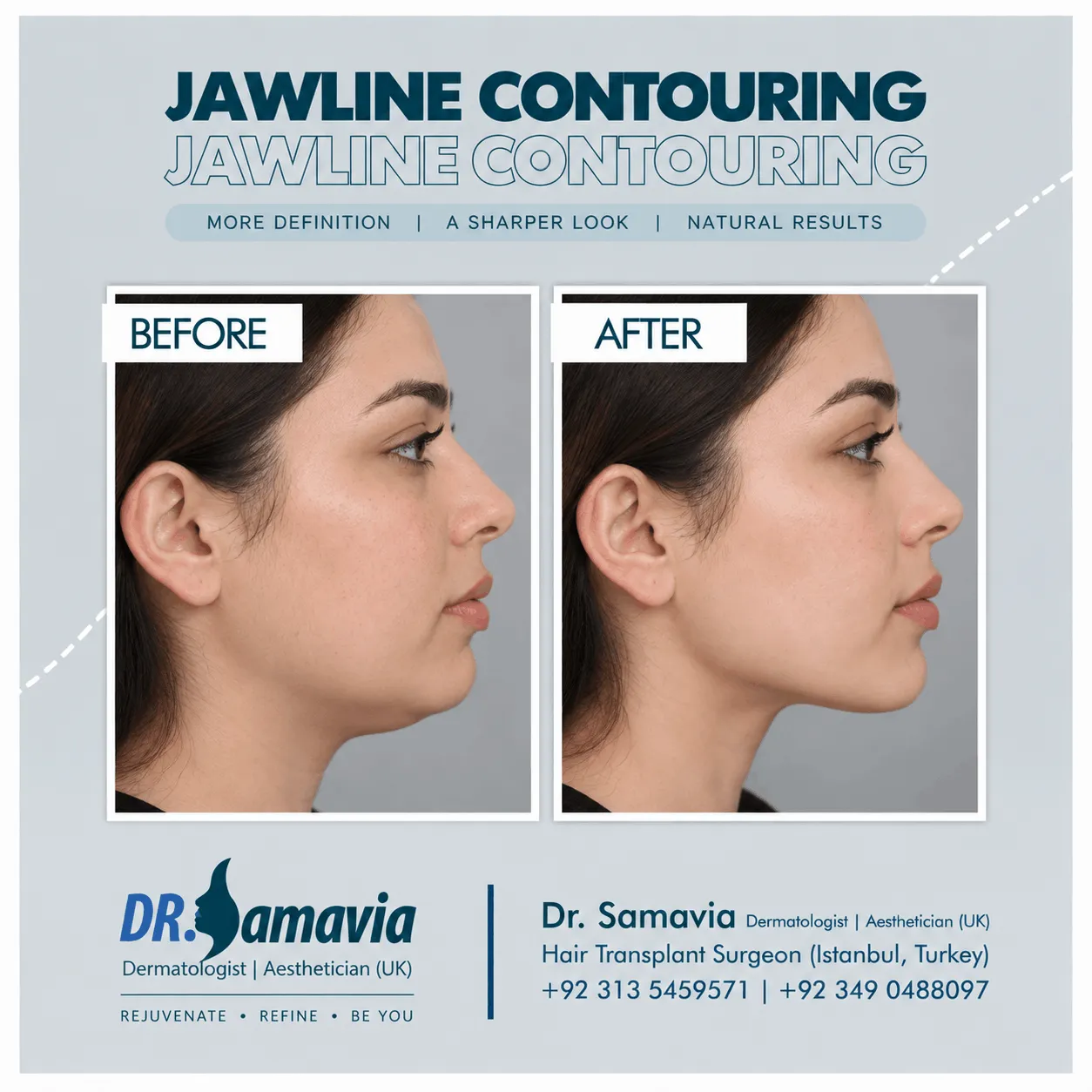
What is Jawline Contouring?
Jawline Contouring refers to aesthetic procedures used to modify the appearance and definition of the jaw, chin and lower face.
The jawline is influenced by several anatomical structures, including:
- Lower jaw bone
- Chin projection
- Masseter muscles
- Facial fat
- Submental fat beneath the chin
- Skin thickness
- Skin elasticity
- Age-related tissue descent
- Overall facial proportions
Because these structures affect the jawline differently, treatment must be selected according to anatomy.
For example, a patient with a small or retruded chin may benefit from structural augmentation, while a patient with a wide lower face caused by large masseter muscles may require a completely different approach.
Non-surgical jawline contouring may include:
- Hyaluronic acid dermal fillers
- Other appropriate dermal filler products
- Botulinum toxin for selected masseter enlargement
- Skin-tightening procedures
- Selected thread treatments
- Treatment of submental fullness where appropriate
Surgical procedures may be more appropriate for significant skeletal imbalance, substantial loose skin or other structural concerns.
What Is Jawline Contouring Used For?
Jawline contouring may be considered for patients seeking improvement in:
- Poorly defined jawline
- Weak-looking lower-face contour
- Limited chin projection
- Mild facial asymmetry
- Wide lower face caused by prominent masseter muscles
- Early jowling
- Loss of jawline definition with ageing
- Mild skin laxity
- Transition between the chin and jaw
- Overall lower-face proportions
Dermal fillers can add volume and projection to selected areas of the jawline and chin. The FDA has cleared specific dermal filler products for particular facial indications, including augmentation of the jawline or chin in adults, although approval applies to the specific product and indication rather than every filler.
Treatment should therefore be planned according to the exact product, anatomy and intended outcome.
What concerns can it address?
Weak jawline definition
Selected dermal fillers can add structural volume along the lower-face contour and make the jawline appear more defined.
Limited chin projection
The chin contributes significantly to overall lower-face balance.
Selected filler treatment may improve chin projection in appropriate patients and can influence how the jawline appears in profile.
Wide or square lower face
In some patients, prominent masseter muscles contribute to a broad or square-looking jaw.
Botulinum toxin can temporarily reduce masseter muscle activity and, over time, may reduce muscle bulk in selected patients.
This treatment is different from jawline filler because it generally reduces width rather than adding structural volume.
Early jowling
Mild jowls may sometimes be visually improved by carefully supporting selected areas of the lower face.
However, filler alone cannot reliably correct substantial tissue descent or loose skin.
Mild skin laxity
Energy-based tightening or selected thread procedures may sometimes be considered where reduced skin firmness contributes to poor jawline definition.
Facial asymmetry
Careful treatment may improve selected volume-related differences between the two sides of the lower face.
Perfect facial symmetry cannot be guaranteed because some natural asymmetry is normal.
Potential benefits
Depending on the treatment selected, potential benefits may include:
- Improved jawline definition
- Enhanced chin-to-jaw balance
- Improved lower-face proportions
- Increased structural definition with filler
- Reduction of selected masseter prominence with botulinum toxin
- Minimally invasive treatment options
- Relatively short treatment sessions
- Limited downtime with many non-surgical procedures
- Ability to personalise treatment according to facial anatomy
- Immediate visible contour change with many dermal fillers
Non-surgical jawline contouring can be useful for selected patients seeking moderate improvement without surgery.
The American Society of Plastic Surgeons notes that dermal fillers can increase jawline definition and chin projection, but also emphasizes that some patients with loose skin or greater structural concerns may require surgical treatment instead.
Limitations and realistic expectations
Jawline Contouring does not have one universal result.
Treatment cannot automatically create an extremely sharp or sculpted jawline in every patient.
Results are affected by:
- Skeletal anatomy
- Chin position
- Amount of facial fat
- Submental fullness
- Skin laxity
- Masseter size
- Facial proportions
- Age
- Filler product
- Amount injected
- Injection technique
Dermal filler cannot remove significant loose skin.
Botulinum toxin cannot create additional bone projection.
Skin-tightening treatments cannot replace significant skeletal augmentation.
Patients should therefore be cautious of claims such as:
- “Permanent V-line jaw”
- “Surgical result without surgery”
- “Perfect jawline guaranteed”
- “Zero-risk jaw filler”
- “Instant permanent face slimming”
- “Same jawline for every patient”
Over-contouring with filler can actually make the lower face appear wider or heavier rather than more defined.
Treatment should therefore prioritise facial balance rather than simply injecting larger amounts of filler.
Who may be suitable?
Jawline Contouring may be considered for adults with:
- Mildly weak jawline definition
- Limited chin projection
- Mild lower-face asymmetry
- Selected masseter enlargement
- Early age-related jawline changes
- Mild jowling
- Realistic expectations regarding non-surgical treatment
A consultation may evaluate:
- Facial profile
- Chin position
- Jaw width
- Masseter strength
- Jawbone structure
- Skin laxity
- Submental fat
- Existing fillers
- Dental and bite relationship
- Previous facial surgery
- Medical history
- Treatment goals
Both front and profile assessment are useful when planning lower-face contouring.
Standardised photographs may also be taken before treatment.
Who may not be suitable?
Jawline Contouring may need to be postponed or modified in patients with:
- Active infection in the treatment area
- Significant skin inflammation
- Known allergy to a proposed filler
- Certain bleeding or clotting disorders
- Significant uncontrolled medical illness
- Previous serious injectable complications
- Unrealistic expectations
- Severe facial or neck skin laxity
Patients with significant skeletal or bite abnormalities may require assessment by an appropriately qualified surgical or dental specialist rather than cosmetic filler treatment alone.
Additional caution may be appropriate for patients with:
- Previous permanent fillers
- Facial implants
- Autoimmune or inflammatory conditions
- Significant abnormal scarring
- Neuromuscular disorders when botulinum toxin is being considered
- Previous jaw surgery
Pregnancy or breastfeeding should be discussed before elective aesthetic treatment.
How to prepare
Before Jawline Contouring, tell your clinician about:
- Prescription medication
- Blood-thinning medicines
- Aspirin or anti-inflammatory medicines
- Supplements
- Allergies
- Previous dermal fillers
- Previous botulinum toxin treatment
- Thread treatments
- Facial surgery
- Jaw surgery
- Dental implants
- Recent dental work
- Medical conditions
- Previous injectable complications
- Pregnancy or breastfeeding
The clinician should explain which treatment is being recommended and why.
For dermal filler, you should know:
- Product name
- Filler material
- Amount planned
- Areas being treated
- Expected longevity
- Potential risks
For botulinum toxin, the treatment plan should consider:
- Masseter strength
- Facial width
- Bite and chewing function
- Existing lower-face proportions
Do not stop prescribed medicines unless advised by the clinician responsible for those medicines.
How the procedure works
The exact procedure depends on the reason for jawline treatment.
1. Facial assessment
The clinician assesses the face from multiple angles and identifies whether the concern relates primarily to:
- Bone structure
- Volume
- Muscle
- Fat
- Skin laxity
- A combination of factors
2. Treatment planning
The most appropriate treatment or combination is selected.
3. Skin preparation
The treatment area is cleaned and disinfected.
4. Pain control
Topical anaesthesia, local anaesthesia or cooling may be used depending on the procedure.
5. Treatment
Dermal Filler Jawline Contouring
Small amounts of filler may be placed in selected areas such as:
- Chin
- Jaw angle
- Pre-jowl region
- Selected sections along the mandibular border
The objective is to improve structural definition while maintaining natural proportions.
Masseter Botulinum Toxin
Botulinum toxin may be injected into selected portions of an enlarged masseter muscle.
The aim is to temporarily reduce muscle activity, which may gradually reduce muscular prominence.
Other Treatments
Where skin laxity or submental fullness is contributing to the concern, a different or additional treatment may be recommended.
6. Final assessment
Symmetry, contour and the immediate treatment response are assessed.
7. Aftercare
The patient receives procedure-specific instructions and information regarding warning symptoms.
Results and treatment timeline
The timeline depends on the treatment used.
Jawline Dermal Filler
Structural contour changes are usually visible immediately.
However, swelling can temporarily change the appearance during the first several days.
A more useful assessment is generally possible after swelling settles.
Masseter Botulinum Toxin
The muscle does not immediately become smaller.
Reduced muscle activity develops first, followed by gradual changes in muscle prominence.
Visible facial slimming may take several weeks to become apparent.
Skin-tightening treatments
Results generally develop more gradually as tissue remodelling occurs.
Thread treatment
Some mechanical contour change may be visible early, although swelling and tissue settling influence the initial result.
Because several different procedures can be used for jawline contouring, a single results timeline should not be promised for every patient
Risks and side effects
Risks depend on the treatment selected.
Dermal Filler Risks
Common temporary effects include:
- Swelling
- Bruising
- Redness
- Tenderness
- Pain
- Itching
- Temporary asymmetry
Other complications can include:
- Infection
- Persistent swelling
- Nodules
- Granulomas
- Filler migration
- Contour irregularity
- Overfilling
- Delayed inflammatory reactions
Vascular Occlusion
The most important uncommon filler complication is accidental injection into a blood vessel.
This can reduce blood supply to tissue and may result in:
- Severe pain
- Skin blanching
- Grey, blue or mottled skin
- Tissue damage
- Skin necrosis
- Scarring
The FDA identifies accidental intravascular injection as the most serious dermal-filler risk. Rare reported consequences include tissue necrosis, visual abnormalities including blindness, and stroke.
Severe unusual pain, colour change or visual symptoms require immediate medical assessment.
Masseter Botulinum Toxin Risks
Potential effects can include:
- Injection-site discomfort
- Bruising
- Temporary chewing weakness
- Facial asymmetry
- Altered smile if nearby muscles are affected
- Excessive reduction in lower-face volume
- Unwanted weakness
Botulinum toxin also carries rare risks associated with spread of toxin effect beyond the intended treatment area.
Other Procedures
Thread and energy-based treatments have their own risks and should have separate informed-consent discussions.
Recovery and aftercare
Recovery depends on the treatment performed.
After injectable jawline contouring, temporary:
- Swelling
- Tenderness
- Bruising
- Redness
may occur.
Patients may be advised to:
- Avoid unnecessary rubbing or pressure.
- Avoid attempting to reshape filler themselves.
- Avoid strenuous exercise for a short period when advised.
- Avoid excessive heat or sauna temporarily.
- Follow instructions regarding makeup and skincare.
- Avoid facial massage until approved.
- Attend follow-up when recommended.
After masseter botulinum toxin treatment, the area should not be aggressively massaged unless specifically instructed.
Contact the clinic for:
- Increasing pain
- Severe swelling
- Persistent redness
- Pus or discharge
- Significant asymmetry
- Persistent weakness
- Another unexpected reaction
Following filler treatment, seek urgent medical attention for:
- Severe or increasing unusual pain
- White, grey or blue skin
- Sudden visual symptoms
- Loss of vision
- Facial weakness
- Difficulty speaking
- Other neurological symptoms
Alternatives and comparisons
Alternatives depend on what is causing poor jawline definition.
Options may include:
- No treatment
- Chin filler
- Jawline filler
- Masseter botulinum toxin
- Thread lift
- Energy-based skin tightening
- Treatment for submental fullness
- Chin implant
- Neck lift
- Facelift
- Orthognathic or jaw surgery when medically or structurally appropriate
Jawline Filler vs Masseter Botox
Jawline filler adds structural volume and can increase definition or projection.
Masseter Botox temporarily reduces activity in enlarged jaw muscles and may gradually make a muscular lower face appear narrower.
They address different anatomical problems.
A patient with an already wide lower face may not benefit from adding substantial filler along the entire jaw.
Jawline Contouring vs Chin Filler
Chin filler focuses primarily on chin projection, length or shape.
Jawline contouring may involve the chin but can additionally address the mandibular border, jaw angle or other lower-face structures.
Sometimes improving the chin alone creates enough improvement that extensive jaw filler is unnecessary.
Jawline Contouring vs Thread Lift
Thread lifting attempts to reposition mildly sagging soft tissue.
Filler primarily changes volume and structural contour.
Neither should automatically be used when substantial loose skin is the main concern.
Non-Surgical Jawline Contouring vs Surgery
Non-surgical treatments are generally more appropriate for mild to moderate cosmetic changes.
Surgical treatment may provide greater correction for:
- Significant loose skin
- Major skeletal imbalance
- Significant chin deficiency
- Advanced jowling
- Structural jaw abnormalities
The American Society of Plastic Surgeons emphasizes that some patients seeking jawline improvement may benefit from filler, while others require surgical procedures to address the actual anatomical cause.
What affects the cost?
The cost of Jawline Contouring depends on:
- Treatment method
- Filler product
- Amount of filler required
- Botulinum toxin dose where used
- Number of treatment areas
- Chin treatment requirements
- Facial anatomy
- Degree of correction
- Previous filler
- Combination treatments
- Practitioner expertise
- Follow-up requirements
A fixed number of filler syringes should not automatically be prescribed for every jawline.
Some patients require only targeted chin or pre-jowl correction, while others require a broader treatment plan.
The treatment goal should be anatomical balance rather than simply using the maximum possible amount of product.
Patient experiences
Reviews describe individual experiences and do not predict another patient's result.
I had a wonderful experience consulting with Dr. Samaviya Ejaz. She is an incredibly impressive and professional dermatologist. Her clinic is beautiful and has a calming atmosphere.
Umar Shah
Read on GoogleI had my hair fall consultation with Dr Samavia. She thoroughly explained the treatment. After PRF sessions my hair fall stopped and density improved. Highly recommend.
Moneeb Mumtaz
Read on GoogleI have had a few treatments at this clinic and I am happy with the outcomes. Dr. Samavia and her team are kind, professional, and trustworthy.
Sheikh Yousuf Kareem
Read on GoogleVisit Dr Samavia at Facetime Clinic
Use the verified Google profile for clinic directions, business details and linked patient reviews.
Clinical references
- Dermal Fillers (Soft Tissue Fillers)U.S. Food and Drug Administration · accessed 29 August 2026
- Dermal Filler Do's and Don'ts for Wrinkles, Lips and MoreU.S. Food and Drug Administration · accessed 29 August 2026
- Chin and Neck Contouring / Jawline ContouringSociety of Plastic Surgeons · accessed 29 August 2026
- Chin SurgeryAmerican Society of Plastic Surgeons · accessed 29 August 2026
- Botulinum Toxin TherapyAmerican Academy of Dermatology · accessed 29 August 2026
- Dermal Fillers: Risks and SafetyAmerican Society of Plastic Surgeons · accessed 29 August 2026
Jawline Contouring FAQs
What is Jawline Contouring?
Jawline Contouring is a personalised aesthetic approach used to improve the definition or proportions of the lower face. Depending on anatomy, treatment may involve dermal filler, masseter botulinum toxin, skin-tightening procedures, threads or surgical options. There is no single jawline-contouring procedure suitable for everyone.
How long does Jawline Filler last?
The duration depends on the filler product, amount, treatment location and individual metabolism. Most absorbable dermal fillers are temporary and gradually break down. Some structural fillers may persist longer than softer fillers, but a precise duration should be discussed for the exact product being used rather than guaranteed in advance.
Does Jawline Contouring make the face look slimmer?
It can in selected patients, but the effect depends on why the lower face appears broad or undefined. Masseter botulinum toxin may gradually reduce a muscularly wide lower face, while strategically placed filler can improve definition and proportions. Excessive filler can instead make some faces appear wider, so anatomical assessment is important.
What is the difference between Jawline Filler and Masseter Botox?
Jawline filler adds structural volume and can improve projection or definition. Masseter Botox temporarily reduces activity in enlarged chewing muscles and may gradually reduce their prominence. One treatment adds volume while the other can reduce muscular width, so they should not be considered interchangeable.
Is Jawline Contouring permanent?
Most non-surgical jawline-contouring treatments are temporary. Hyaluronic acid filler gradually breaks down, botulinum toxin effects wear off and many skin-tightening treatments require maintenance. Surgical procedures can produce longer-lasting structural changes but have different risks and recovery requirements.
Other Face Treatments guides
Book a consultation in Islamabad to review suitability, alternatives, expected recovery and individual risks.