Laser Hair Removal in Islamabad
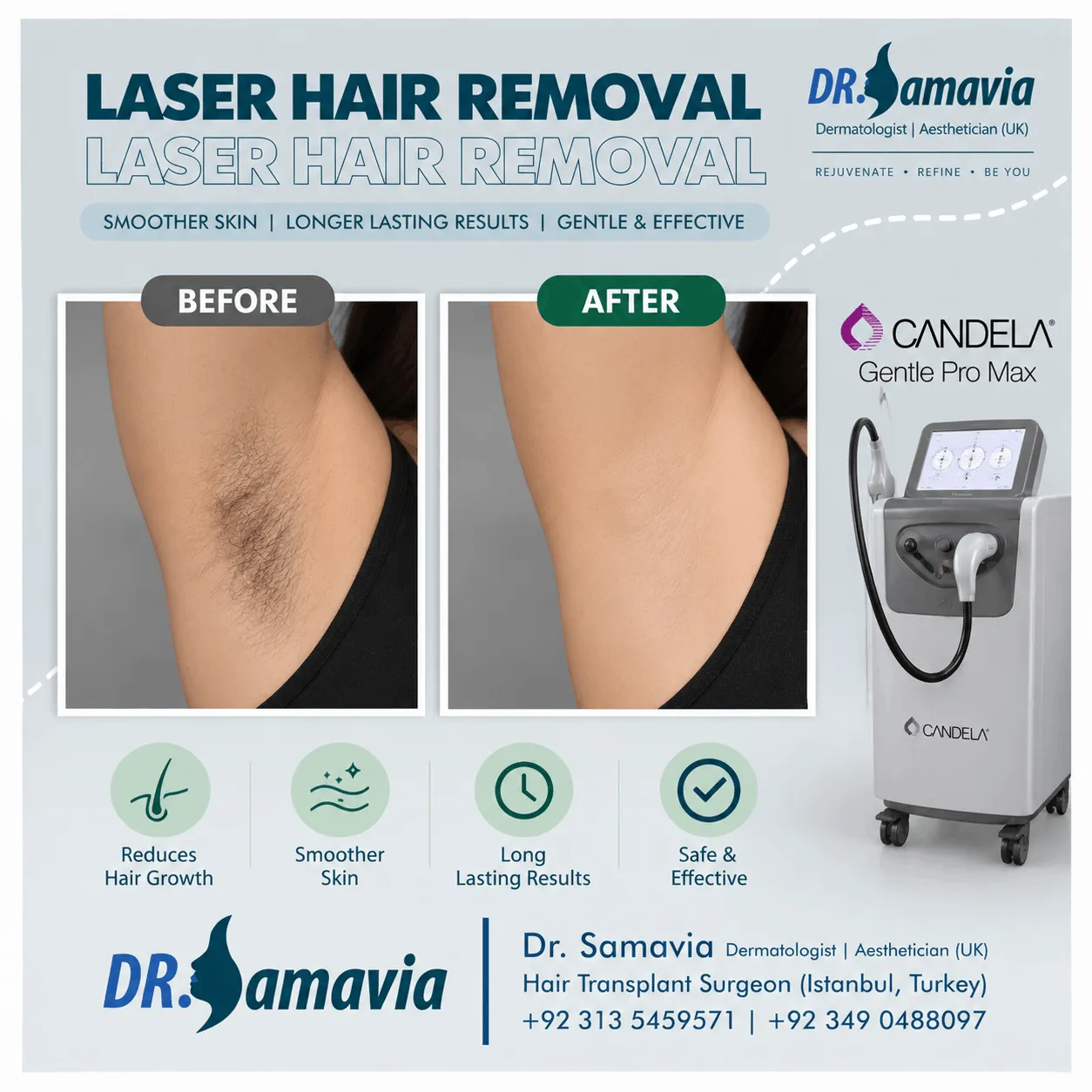
Laser Hair Removal is a non-surgical procedure that uses concentrated light energy to target pigment within unwanted hair. The absorbed light is converted into heat, which damages selected hair follicles and reduces their ability to produce future hair.
Laser hair removal can produce substantial and long-lasting hair reduction, but it should not be presented as guaranteed removal of every hair permanently. Multiple sessions are required because the laser works most effectively on hairs in an active growth phase, and some regrowth can occur over time.
What is Laser Hair Removal?
Laser Hair Removal is a medical aesthetic procedure that uses a controlled beam of light to reduce unwanted facial or body hair.
The laser is designed to target melanin, the pigment found in hair.
When suitable laser energy is absorbed by pigment in the hair shaft and follicular structures, it is converted into heat. This thermal effect damages the follicle sufficiently to delay or reduce future hair growth while attempting to protect the surrounding skin.
Laser treatment works best when there is sufficient pigment in the hair for the laser to target.
Different hair-removal systems use different wavelengths and technologies. Common examples include:
- Alexandrite laser
- Diode laser
- Nd laser
- Other medically appropriate light-based hair-reduction systems
The appropriate system and settings depend on factors such as:
- Skin colour
- Hair colour
- Hair thickness
- Treatment area
- Recent sun exposure
- Previous laser response
Modern laser systems can be used in patients with a wide range of skin tones when an appropriate device and settings are selected by an experienced practitioner.
What Is Laser Hair Removal Used For?
Laser Hair Removal is primarily used to reduce unwanted hair on the face and body.
Common treatment areas include:
- Upper lip
- Chin
- Face
- Neck
- Underarms
- Arms
- Hands
- Chest
- Abdomen
- Back
- Shoulders
- Bikini area
- Legs
- Feet
It can also be useful for patients who repeatedly develop:
- Razor irritation
- Shaving-related bumps
- Ingrown hairs
- Skin irritation from frequent waxing or shaving
The American Academy of Dermatology lists the face, underarms, back, bikini area, chest, legs, neck and shoulders among commonly treated areas.
Treatment close to the eyes requires particular caution. Laser hair removal should not be performed directly on the eyelids, eyebrows or immediately surrounding eye area because of the potential risk of serious eye injury.
What concerns can it address?
Unwanted facial hair
Laser treatment may reduce unwanted hair on areas such as the upper lip, chin, jaw or selected parts of the face.
Facial hair influenced by hormones may require ongoing maintenance because laser treatment removes or reduces existing hairs but does not necessarily correct the underlying hormonal stimulus.
Underarm hair
Underarm hair commonly responds well when the hair is dark and coarse enough to absorb laser energy effectively.
Bikini-area hair
Laser treatment may reduce coarse unwanted hair and help reduce repeated irritation from shaving or waxing.
Leg and arm hair
Relatively large areas can be treated, although session duration depends on the size of the treatment area and technology used.
Back and chest hair
Laser treatment may provide progressive reduction across large areas in appropriate patients.
Ingrown-hair concerns
Reducing coarse terminal hair can help selected patients who repeatedly experience ingrown hairs following shaving or other hair-removal methods.
Treatment does not, however, replace medical assessment where significant inflammation, infection or another skin disorder is present.
Potential benefits
Potential benefits of Laser Hair Removal include:
- Long-lasting reduction in unwanted hair
- Less frequent need for shaving or waxing
- Can treat both small and relatively large areas
- No surgical incisions
- Usually minimal downtime
- Progressive reduction with repeated treatments
- Regrowing hair may appear finer or lighter in some patients
- May help reduce shaving-related irritation
- Can be used across a range of skin tones with appropriate technology and settings
- Maintenance treatment can be performed if hair regrows
Mayo Clinic notes that laser treatment can greatly reduce hair growth and that when hair eventually regrows it may be finer and lighter than before.
Limitations and realistic expectations
Laser Hair Removal should be described as long-term or permanent hair reduction, rather than guaranteeing permanent elimination of every hair.
The FDA has used the term permanent hair reduction to describe a long-term, stable reduction in the number of hairs that regrow after completion of a treatment course. It does not mean every hair in the treatment area will necessarily disappear forever.
Results depend on:
- Hair colour
- Hair thickness
- Skin colour
- Hair-growth cycle
- Treatment area
- Laser wavelength
- Energy settings
- Hormonal influences
- Number of sessions
- Treatment consistency
Laser treatment is generally most responsive when hair contains substantial dark pigment.
It is usually much less effective for:
- White hair
- Grey hair
- Very light blonde hair
- Some red hair
This occurs because these hairs contain insufficient melanin of the type required for effective laser targeting.
Patients should therefore be cautious of claims such as:
- “100% permanent hair removal”
- “All hair removed in one session”
- “Works equally well on every hair colour”
- “Zero chance of burns”
- “No maintenance ever required”
- “Same laser setting for every skin type”
These claims are not realistic.
Why are multiple sessions required?
Hair follicles do not all grow at the same time.
Hair goes through different phases of a growth cycle, including active growth and resting phases.
Laser treatment is particularly effective when an appropriate hair follicle is in an active growth stage and contains sufficient pigment.
Because only a proportion of hairs are in the optimal phase during any one appointment, repeated treatment is needed to target additional follicles as they cycle into active growth.
Mayo Clinic states that most patients require approximately 4 to 8 treatments, while the American Academy of Dermatology notes that removing unwanted hair can take 6 sessions or more.
The appropriate interval between sessions also depends on the body area because hair-growth cycles differ between facial and body hair.
Who may be suitable?
Laser Hair Removal may be considered for adults seeking reduction of unwanted dark or pigmented hair.
Potential candidates may include people with:
- Unwanted facial hair
- Underarm hair
- Bikini-area hair
- Leg hair
- Arm hair
- Back or chest hair
- Shaving-related irritation
- Recurrent ingrown hairs
- Realistic expectations regarding reduction rather than guaranteed total removal
Suitability depends on the relationship between skin colour and hair colour.
Historically, laser hair removal was easiest in patients with light skin and dark hair because of the strong pigment contrast.
Modern technologies have expanded treatment possibilities for people with darker skin tones. However, correct device selection and settings are particularly important because darker skin contains more melanin, which also absorbs laser energy.
An experienced practitioner should therefore assess the patient's individual skin and hair characteristics.
Who may not be suitable?
Treatment may need to be postponed, modified or avoided in patients with:
- Active infection in the treatment area
- Open wounds
- Significant active skin inflammation
- Recent significant tanning
- Sunburn
- Certain photosensitive conditions
- Certain photosensitising medications
- Previous unusual reactions to laser treatment
Patients with a history of:
- Keloid scarring
- Significant pigmentation changes
- Cold sores
- Abnormal scarring
should disclose this before treatment.
The AAD also recommends informing the treating clinician about recent tanning, tendency to scar, keloid formation, cold sores and medications before undergoing laser hair removal.
Pregnancy should be discussed with the treating clinician. Because cosmetic laser hair removal is elective and adequate pregnancy-specific evidence is limited, treatment is commonly postponed until after pregnancy.
Hormonal hair growth
Excess facial or body hair can sometimes be associated with underlying hormonal conditions.
Laser Hair Removal can reduce the visible hairs but does not treat the hormonal cause.
If new hairs continue to be hormonally stimulated, additional growth may occur despite successful treatment of existing follicles.
Assessment may therefore be appropriate when unwanted hair is accompanied by other symptoms or develops unexpectedly.
Mayo Clinic specifically notes that laser treatment does not correct the underlying medical cause of hormonally driven unwanted hair and ongoing treatment may be required.
How to prepare
Preparation is important for both safety and treatment effectiveness.
Before treatment, tell the practitioner about:
- Prescription medications
- Over-the-counter medicines
- Photosensitising medication
- Previous isotretinoin use
- Previous laser treatment
- Recent tanning
- Sunburn
- Skin conditions
- Abnormal scarring
- Keloid history
- Cold sores
- Pregnancy
- Previous burns or pigmentation following laser
Avoid tanning
Avoid intentional tanning and tanning beds before treatment.
A recent tan increases melanin in the skin and can increase the risk of burns and pigment changes.
Use broad-spectrum sunscreen with SPF 30 or higher according to your clinician's instructions.
Do not wax or pluck
Waxing, plucking and electrolysis remove the hair structure the laser needs to target.
Mayo Clinic recommends avoiding these methods for at least approximately four weeks before treatment.
Shaving
The treatment area is commonly shaved shortly before the procedure.
Shaving removes hair above the skin while leaving the target within the follicle available for laser treatment.
Your clinic may recommend shaving the day before or according to its specific protocol.
How the procedure works
Consultation and assessment
Skin tone, hair colour, hair thickness, treatment area and medical history are reviewed.
2. Treatment planning
An appropriate laser system, wavelength and treatment parameters are selected.
3. Preparation
The area is cleaned and excessive surface hair may be shaved if required.
4. Eye protection
Appropriate protective eyewear is worn because laser energy can seriously damage the eyes.
5. Cooling
Many modern laser systems use:
- Contact cooling
- Chilled tips
- Cooling gel
- Cryogen or other cooling systems
to protect the skin and improve comfort.
6. Laser delivery
The handpiece delivers controlled pulses of laser energy to the treatment area.
Patients may feel:
- Warmth
- A brief snapping sensation
- Mild stinging
Mayo Clinic compares the sensation to a rubber band snapping against the skin.
7. Post-treatment assessment
The area is checked for redness, swelling or unexpected skin reaction.
8. Treatment scheduling
The next session is planned according to the body area, hair-growth cycle and treatment response.
Results and treatment timeline
Laser Hair Removal produces progressive rather than instant complete hair removal.
Immediately after treatment
The skin may develop:
- Redness
- Mild swelling around follicles
- Warmth
- Temporary sensitivity
Several days to weeks
Treated hairs gradually shed.
Mayo Clinic notes that treated hairs do not fall out immediately but typically shed over several days to weeks.
After multiple sessions
Progressively fewer hairs may regrow.
Remaining hairs can become:
- Finer
- Lighter
- Less noticeable
- Slower growing
After completing a course
Many patients achieve substantial long-term reduction.
However, some follicles may recover or previously inactive follicles may later produce hair.
Maintenance
Occasional maintenance treatment may be useful when regrowth occurs.
Hormonal facial hair, particularly in women, may require more maintenance than many body areas. The AAD specifically notes that hormonal influences can prevent permanent facial results in women.
Risks and side effects
Common temporary effects include:
- Redness
- Mild swelling
- Warmth
- Tenderness
- Temporary irritation
These effects commonly resolve within several hours, although individual recovery varies.
Pigmentation changes
The treated skin can temporarily become:
- Darker — hyperpigmentation
- Lighter — hypopigmentation
Rarely, these changes may persist.
The risk can be greater when inappropriate laser settings are used, particularly in darker skin, or when patients do not appropriately avoid sun exposure.
Burns and blistering
Excessive energy or inappropriate device settings can produce:
- Burns
- Blisters
- Crusting
- Skin injury
Correct technology, settings, cooling and operator experience help reduce these risks.
Scarring
Scarring is uncommon but possible following excessive skin injury.
Texture changes
Uncommon changes in skin texture can occur.
Paradoxical hair growth
Rarely, hair around or within the treated area may become thicker or more noticeable rather than decreasing.
Mayo Clinic specifically lists thicker hair growth around treated skin as a rare potential side effect.
Eye injury
Laser exposure can damage the eyes.
Appropriate eye protection is essential, and treatment should not be performed directly on eyelids, eyebrows or the immediately surrounding area.
Recovery and aftercare
Most patients require little downtime following uncomplicated Laser Hair Removal.
Temporary redness or swelling can often be managed with cooling measures recommended by the treatment provider.
Patients may be advised to:
- Avoid unnecessary rubbing or scratching.
- Avoid excessive heat temporarily.
- Avoid hot baths or sauna when advised.
- Avoid strenuous exercise for a short period if the skin is irritated.
- Avoid tanning.
- Protect the treated area from excessive sun exposure.
- Use broad-spectrum SPF 30+ sunscreen on exposed skin.
- Avoid waxing or plucking between laser sessions.
- Shave between sessions if hair removal is necessary and your clinician permits it.
- Avoid applying irritating skincare immediately after facial treatment.
Mayo Clinic recommends careful sun protection between sessions and broad-spectrum SPF 30 or higher.
Contact the clinic if you develop:
- Severe or increasing pain
- Significant blistering
- Extensive crusting
- Persistent swelling
- Significant darkening or whitening of the skin
- Pus or discharge
- Another unexpected reaction
Alternatives and comparisons
Alternatives for unwanted hair include:
- Shaving
- Waxing
- Threading
- Tweezing
- Depilatory creams
- Electrolysis
- Medical treatment of an underlying hormonal cause where appropriate
Laser Hair Removal vs Waxing
Waxing physically removes hair from the follicle but does not intentionally damage the follicular structures responsible for producing future hair.
Hair therefore grows back and waxing needs to be repeated.
Laser treatment aims to progressively reduce follicular hair production over multiple sessions.
Laser Hair Removal vs Shaving
Shaving cuts hair at the skin surface.
It is inexpensive and convenient but requires frequent repetition.
Laser treatment requires a larger initial treatment commitment but may provide substantial long-term reduction.
Laser Hair Removal vs Electrolysis
Electrolysis uses a fine probe and electrical energy to destroy individual hair follicles.
Because individual follicles are treated separately, electrolysis can be time-consuming for large areas.
Unlike pigment-targeting lasers, electrolysis may also be an option for some light-coloured hairs that respond poorly to laser.
Laser vs IPL Hair Reduction
A true laser emits light with specific laser characteristics and wavelengths.
IPL (Intense Pulsed Light) uses a broad spectrum of light rather than a laser beam.
Both can be used for hair reduction, but they are different technologies.
Results and suitability depend on the device, skin type, hair colour, settings and practitioner expertise.
What affects the cost?
The cost of Laser Hair Removal depends on factors including:
- Size of the treatment area
- Number of sessions
- Laser technology used
- Hair density
- Hair thickness
- Skin type
- Facial versus body treatment
- Whether multiple areas are treated
- Maintenance requirements
A small area such as the upper lip requires substantially less treatment time than full legs, back or full-body treatment.
The cheapest treatment should not automatically be considered the best option.
Important factors include:
- Genuine medical-grade equipment
- Appropriate technology for the patient's skin type
- Operator training
- Correct treatment parameters
- Adequate cooling
- Proper eye protection
- Ability to identify and manage complications
Patient experiences
Reviews describe individual experiences and do not predict another patient's result.
I had a wonderful experience consulting with Dr. Samaviya Ejaz. She is an incredibly impressive and professional dermatologist. Her clinic is beautiful and has a calming atmosphere.
Umar Shah
Read on GoogleI had my hair fall consultation with Dr Samavia. She thoroughly explained the treatment. After PRF sessions my hair fall stopped and density improved. Highly recommend.
Moneeb Mumtaz
Read on GoogleI have had a few treatments at this clinic and I am happy with the outcomes. Dr. Samavia and her team are kind, professional, and trustworthy.
Sheikh Yousuf Kareem
Read on GoogleVisit Dr Samavia at Facetime Clinic
Use the verified Google profile for clinic directions, business details and linked patient reviews.
Clinical references
- Laser Hair Removal: OvervieAmerican Academy of Dermatology · accessed 29 August 2026
- Laser Hair Removal: PreparationAmerican Academy of Dermatology · accessed 29 August 2026
- Laser Hair Removal Device — Permanent Hair Reduction Definition and 510(k) DocumentationU.S. Food and Drug Administration · accessed 29 August 2026
- Device, Light Based, Over-the-Counter Hair Removal — Product ClassificationU.S. Food and Drug Administration · accessed 29 August 2026
Laser Hair Removal FAQs
Is Laser Hair Removal permanent?
Laser treatment can produce substantial long-term or permanent hair reduction, but it does not guarantee that every treated hair will disappear permanently. Some follicles can later produce hair again, and hormonal changes can stimulate new growth. Maintenance treatment may therefore be required.
How many Laser Hair Removal sessions do I need?
Most patients require multiple treatments because hairs grow in different cycles. Mayo Clinic states that many patients require approximately 4 to 8 sessions, while the American Academy of Dermatology notes that 6 or more treatments may be needed. The exact number depends on the treatment area, hair characteristics, skin type and individual response.
Does Laser Hair Removal work on all skin types?
Modern laser technologies allow treatment across a broad range of skin tones. However, darker skin contains more melanin, so careful selection of the laser wavelength and treatment settings is particularly important to reduce the risk of burns or pigmentation changes. Experience treating the patient's skin type is important.
Does Laser Hair Removal work on blonde, grey or white hair?
Results are generally poor for white, grey and very light blonde hair because laser hair-removal systems rely on pigment within the hair to absorb energy. Red hair can also respond less effectively. Electrolysis may be an alternative for selected light-coloured hairs.
Is Laser Hair Removal painful?
Most patients describe brief heat, stinging or a snapping sensation during each laser pulse rather than severe pain. Modern systems may use contact cooling, chilled tips or cooling sprays to protect the skin and improve comfort. Sensitivity varies according to the treatment area and individual.
Other Laser Treatments guides
Book a consultation in Islamabad to review suitability, alternatives, expected recovery and individual risks.